UniFash Guide · Design Process · Collection · International Perspectives

Learn Fashion Design Design process, collection and international perspectives

How does an idea develop into a cohesive fashion collection? This guide explains research, target audience analysis, mood boards, colour and material concepts, fashion illustration, technical drawings, collection development, and portfolios.

Orientation

Was bedeutet Mode-Design?

Fashion design refers to the creative and conceptual development of clothing and collections. This involves not just individual drawings, but a complete process from research to a fully developed fashion idea.

Fashion designers combine social observation, target audience understanding, colour, form, material, and silhouette into a recognisable concept. This concept is then made concrete through drawings, material selection, technical specifications, patterns, and prototypes.

In German-speaking regions, the term 'Modedesign' is frequently used. 'Fashion Design' is the internationally common designation. The content of both terms overlaps significantly, with the English term often being more strongly associated with international branding, collections, and portfolio work.
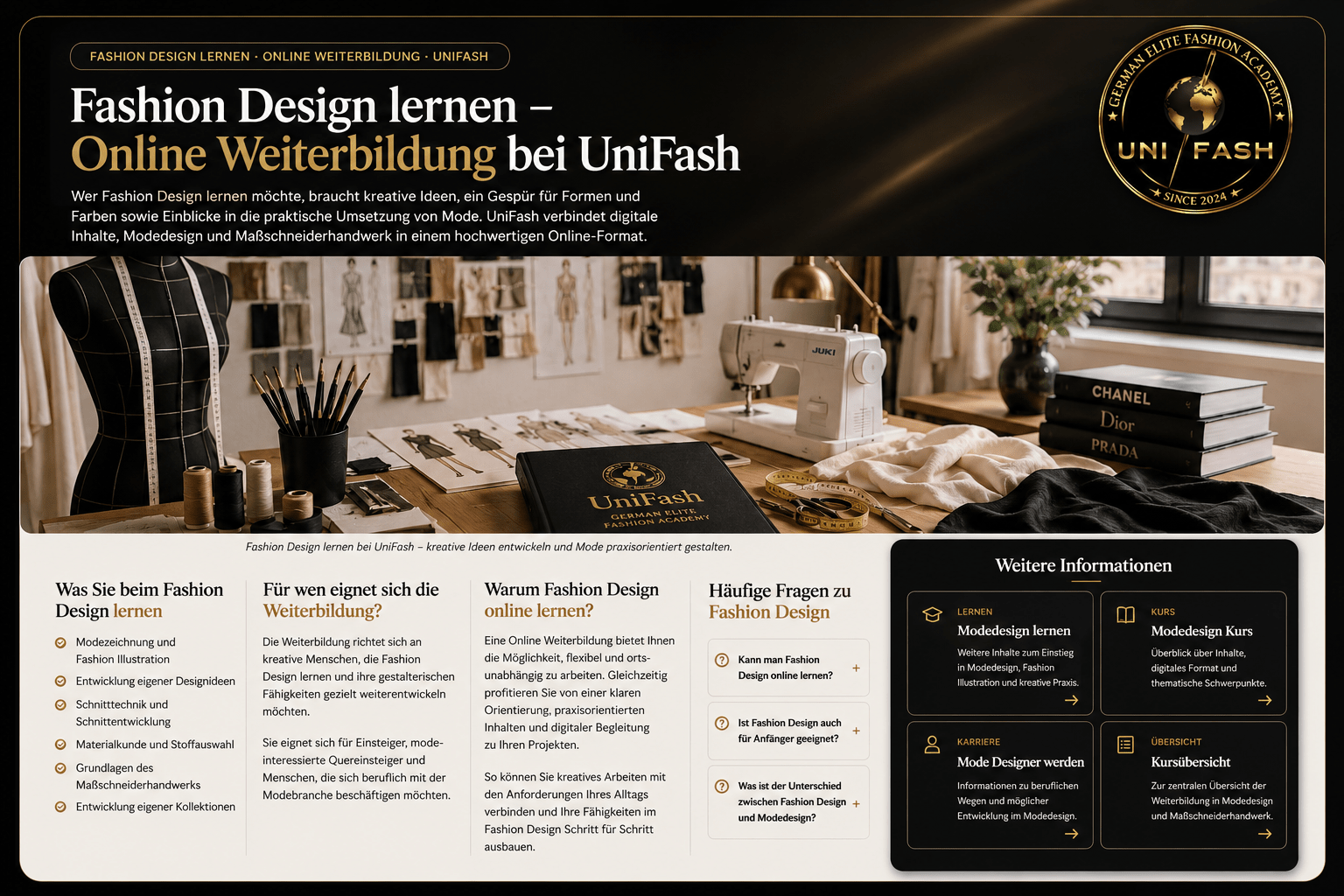
Learn Fashion Design with Research, Moodboards, Fashion Illustration, Material Concepts and Collection Development
Fashion design combines research, creative design, material development, and technical implementation into a cohesive collection.
Research Understanding themes, markets, and target audiences.
Concept Develop moodboard, colours and silhouettes
Collection Connect individual looks into a line.
Portfolio Show process and results professionally
Demarcation

Fashion Design, Styling, Tailoring and Textile Design

Several professions work with clothing, materials, and visual design. However, their tasks differ significantly.

Fashion Design

Develops clothing, collections, silhouettes, colour palettes and design concepts.

Fashion Styling

Combines existing garments for photoshoots, campaigns, shows or individuals.

Bespoke tailoring

Focuses on cut, fit, finishing, and high-quality craftsmanship.

Textile design

Develops surfaces, patterns, prints, structures and textile material concepts.

Product Development

Translates drafts into technically, economically and industrially feasible products.

Creative Direction

Controls the overall visual and content identity of a brand or collection.

Design process

From Research to Fashion Collection

A collection rarely arises from a single spontaneous sketch. Professional fashion design usually follows a structured development process.

1

Theme and research question

The starting point can be a social issue, an era, a material, a person or a specific target group.

2

Research

Images, texts, shapes, colours, materials, historical sources, and cultural influences are collected and analysed.

3

Target audience

Age, lifestyle, usage situation, price level, and the expectations of future wearers are defined.

4

Moodboard

The most important visual stimuli are merged into a clear design direction.

5

Colour concept

Primary colours, accent colours, contrasts and material effects are coordinated.

6

Material Concept

Fabrics are selected based on drape, weight, structure, function, processing, and visual effect.

7

Silhouettes

Volumes, lengths, proportions and recurring shapes are developed and compared.

8

Design development

Numerous variations emerge before the strongest designs are selected for the collection.

9

Fashion illustration

Selected looks are presented atmospherically and stylistically on figurines.

10

Technical drawing

The front, back, details, seams, fastenings, and construction features are precisely documented.

11

Cut and prototype

Designs are transferred into cut shapes and initially realised as trial or sample parts.

12

Review and revision

Fit, material effect, function and design unity are checked and improved.

What makes a collection cohesive?

A collection is more than a group of individual garments. The looks must share a recognisable design language, yet still offer sufficient variety.

Connecting elements

  • recurring colours
  • Related silhouettes
  • uniform materials or surfaces
  • Recurring lines and details
  • shared target audience
  • clearly recognisable basic idea

Necessary Differences

  • different types of clothing
  • different lengths and volumes
  • changing combinations
  • different functions
  • Quiet and eye-catching looks
  • recognisable development within the line
Technical terms

Essential Documents in Fashion Design

Underlay Purpose Typical Content
Research Board Document the content research Images, texts, shapes, sources, cultural and historical references
Moodboard Atmosphere and style condensed Colours, shapes, light, material effects and emotional imagery
Colour Board Defines the colour world Primary colours, accents, contrasts and colour combinations
Fabric Board Material concept Material samples, structures, weights, surfaces, and material combinations
Fashion illustration Communicates atmosphere and design effect Figurines, silhouettes, colours, drape and styling
Technical Drawing Explains the construction of a garment Front and back view, seams, fastenings, pockets, and details
Line-up Shows the entire collection at a glance Sequence, colour distribution, silhouettes and coherence
Portfolio Documents Competence and Development Research, designs, technical work, processes, and results
Portfolio

What should go in a fashion design portfolio?

A portfolio should not just showcase finished images. It should make it understandable how an idea originated, was developed, tested, and implemented.

Research and Concept

Starting topic, image research, target audience, mood board, colour and material concept.

Development process

Sketches, variations, discarded ideas, form experiments, and justifiable decisions.

Design results

Fashion illustrations, line-ups, material presentations and elaborated collection pieces.

Technical competence

Technical drawings, seam development, details, manufacturing, and fit corrections.

Practical implementation

Photos of samples, toile developments, finished garments, and worn looks.

Own handwriting

A recognisable design stance that runs through the selection, presentation, and overall composition.

International Perspective

Why English is important in Fashion Design

Many technical terms, software interfaces, trend reports, material information, and international tenders are used in English. Anyone who wants to work internationally or communicate with international partners should therefore be able to understand important terms from design, production, and collections with confidence.

  • collection development
  • fashion illustration
  • technical drawing
  • Pattern cutting
  • Garment construction
  • Textile procurement
  • target customer
  • Colour palette
  • Scope of work
  • portfolio development

Good technical language does not mean using as many English terms as possible. The crucial point is that design and technical information is communicated clearly, understandably and professionally.

Learning paths

How can one learn fashion design?

The appropriate learning path depends on your goal, available time, prior knowledge, and the desired depth of expertise.

Basics

Self-study and short courses

Suitable for getting to know fashion design initially or for practising individual topics such as fashion illustration, mood boards or portfolio work.

  • Flexible entry
  • individual topics selectable
  • High degree of personal responsibility
  • limited expert feedback possible
Flexible Option

Online learning for self-funders

Useful for people who want to learn independently of location and without a fixed daily full-time structure.

  • Flexible working hours
  • digital access
  • Practical work at home
  • Material costs will be borne by the user
View self-pay option
Formal education

Apprenticeship or university degree

Apprenticeships and university degrees are longer-term pathways with different entry requirements, specialisms, and qualifications.

  • multi-year duration possible
  • Formal requirements
  • varying practical component
  • Institutional completion
Comparing learning paths
Important: Further training is not automatically equivalent to vocational training or university studies. Therefore, always check the duration, content, practical component, qualification, and your own career goals.

Frequently Asked Questions about Fashion Design

These answers help to better categorise the professional field and the learning process.

There is no difference between fashion design and modedesign.

The terms are often used interchangeably. Fashion Design is the internationally used term, while Modedesign is more commonly used in German-speaking countries.

Do you have to be good at drawing?

Perfect artistic drawings are not required at the beginning. It is important to be able to clearly present ideas, silhouettes, details, and material effects. These skills can be trained step by step.

What is more important: creativity or technique?

Both belong together. Creativity develops new ideas and design concepts. Technical and practical knowledge ensures that these ideas become feasible, understandable, and implementable.

Can fashion design be learned online?

Many theoretical, design and demonstrative contents can be conveyed online. However, practical tasks such as material testing, pattern development, and sewing must be carried out by oneself in a suitable workspace.

How do you develop your own collection?

A collection is created from research, target group analysis, mood boards, colour and material concepts, silhouette development, draft variations, selection, technical elaboration, and practical testing.

What should go in a fashion design portfolio?

A good portfolio shows research, concept, design development, fashion illustrations, technical drawings, materials, patterns, prototypes, and finished results.

Do you need a degree for fashion design?

University is one possible educational path, but it's not the only one. Skills can also be developed through apprenticeships, further training, structured courses, professional experience, and self-study.