


Fashion Design Research Further Education as a scientific basis
For UniFash, fashion design research and continuing education form the basis of an educational model that does not separate creative design from practical skills. The research investigates how fashion design, pattern development, sewing techniques, material knowledge, and tailoring can be taught digitally and simultaneously applied in practice.
The fashion industry faces challenges in recruiting new talent, upskilling, and retaining high-quality craft skills. At the same time, traditional processing techniques and sound educational pathways are becoming less accessible for many interested parties.
Many educational programmes either teach creative theory without sufficient practical depth, or provide practical foundations without a modern digital learning framework. This research project focuses precisely on this intersection.
Research question and objective of the Further training in fashion design
The central research question is how a modern fashion design further education programme can be designed to combine digital accessibility, high-quality fashion education and practical craftsmanship.
The focus is not on digitalisation for its own sake. What matters far more is how digital learning structures can be used to convey subject-specific content in a way that is understandable, clear and practical.
The research into fashion design further education at UniFash is not conceived in a detached, theoretical manner. It connects scientific findings with the practical requirements of fashion education, pattern engineering, and the craft of tailoring.
The full Research by Iris Peitzmeier Ph.D
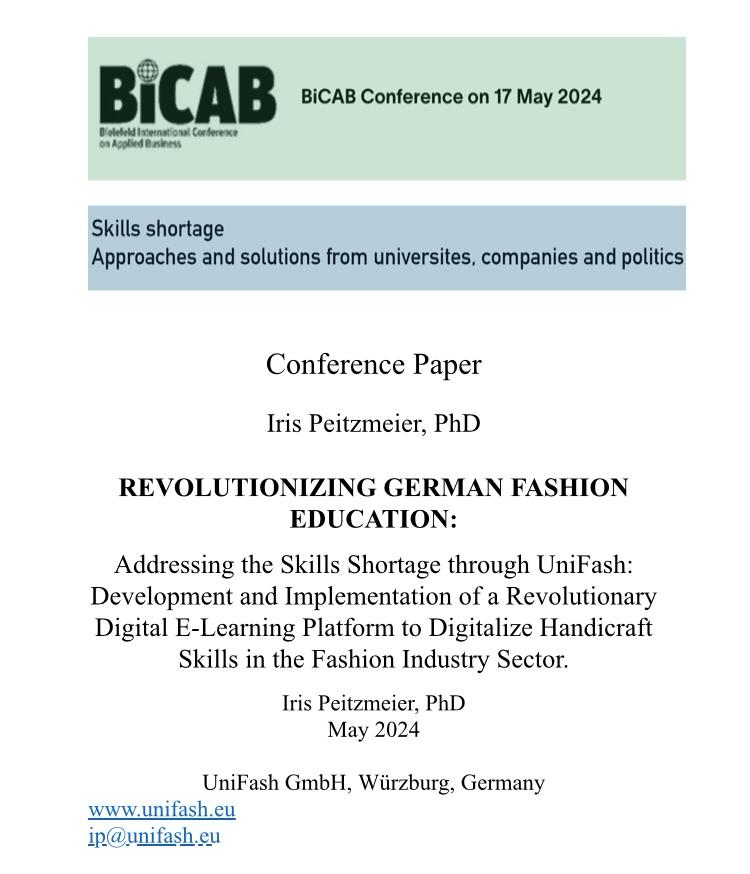
The doctoral thesis „Revolutionising German Fashion Education“ documents the academic development of the UniFash educational model. It examines the future of fashion education, digital learning models and the requirements of the international fashion industry.
Revolutionising German Fashion Education
Read Iris Peitzmeier Ph.D.'s full research paper. The PDF file can be opened directly or downloaded for later use.
Scientific development of UniFash Further Education Programme
The didactic structure of the further education was developed as part of the scientific research work. International designers, fashion experts and representatives of the fashion industry were involved in order to better understand the demands of the industry and the labour market.
The results showed that the fashion industry needs more than just creative ideas. Technical understanding, pattern-cutting expertise, material knowledge, sewing techniques and manual precision are equally important.
This combination of design development and tailoring craftsmanship forms the professional core of the UniFash programme.
Digital fashion education and practical crafts
Digital fashion education is beneficial when practical exercises, comprehensible work processes, professional feedback, and clear learning objectives are an integral part of the educational model.
The UniFash continuing education programme combines digital learning materials with practical tasks in fashion design, pattern-making, sewing techniques and bespoke tailoring. The aim is to ensure that learning is not limited to theoretical knowledge.
Securing skilled workers The future of the fashion industry
A central theme of the research is the question of how qualified skills in the fashion and tailoring trade can be preserved and passed on.
New educational models can help expand access to qualified fashion education and make craftsmanship knowledge accessible to new target groups.
UniFash therefore understands further education not just as a course offering, but as a contribution to safeguarding knowledge, quality, and professional employability in the fashion industry.
Presentation at the BiCAB Conference
The research findings were presented at BiCAB – the Bielefeld International Conference on Applied Business at Bielefeld University of Applied Sciences . The conference focused on the topic of „skills shortages“ and, consequently, on the issue of shortages of skilled workers and suitable solutions.
Connection of Research and Bespoke Tailoring
Alongside the scientific foundation, UniFash places special emphasis on genuine craft knowledge. The content is oriented towards practical requirements and combines traditional processing techniques, pattern development, and high-quality execution with digital learning methods.
Unlike simple video tutorials, this is a structured further training concept with professional depth, didactic development, and concrete practical tasks.
The importance of research for Participants
- Practical content instead of superficial hobby formats
- scientifically developed didactic structure
- Connecting fashion design and tailoring
- Orientation towards the requirements of the fashion industry
- Digital further education with professional depth
- Structured skills development for career prospects
AZAV-certified and Eligible further training
UniFash is an AZAV-certified training provider. The further education can be subsidised via an education voucher from the Employment Agency or the Job Centre, provided that the personal prerequisites are met and the responsible body approves participation.
It is the combination of research, craftsmanship, digital teaching methods and funding eligibility that sets UniFash apart from purely informal online courses.