UniFash Guide · Design Process · Collection · International Perspectives

Learn Fashion Design Design process, collection and international perspectives

How does an idea develop into a cohesive fashion collection? This guide explains research, target audience analysis, mood boards, colour and material concepts, fashion illustration, technical drawings, collection development, and portfolios.

Orientation

Was bedeutet Mode-Design?

Fashion design refers to the creative and conceptual development of clothing and collections. This involves not just individual drawings, but a complete process from research to a fully developed fashion idea.

Fashion designers combine social observation, target audience understanding, colour, form, material, and silhouette into a recognisable concept. This concept is then made concrete through drawings, material selection, technical specifications, patterns, and prototypes.

In German-speaking regions, the term 'Modedesign' is frequently used. 'Fashion Design' is the internationally common designation. The content of both terms overlaps significantly, with the English term often being more strongly associated with international branding, collections, and portfolio work.
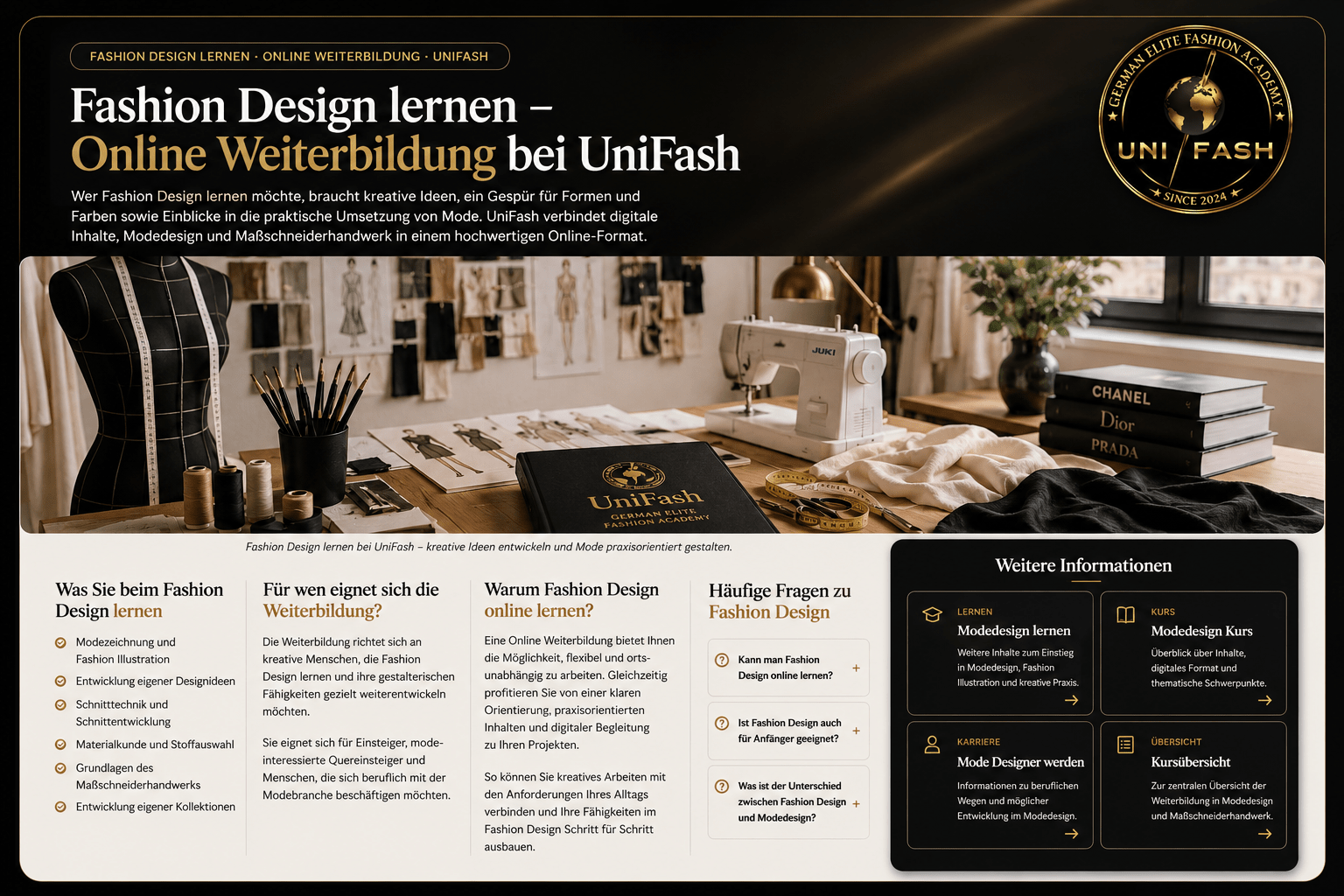
Fashion Design lernen mit Recherche, Moodboard, Fashion Illustration, Materialkonzept und Kollektionsentwicklung
Fashion design combines research, creative design, material development, and technical implementation into a cohesive collection.
Research Understanding themes, markets, and target audiences.
Concept Develop moodboard, colours and silhouettes
Collection Connect individual looks into a line.
Portfolio Show process and results professionally
Demarcation

Fashion Design, Styling, Tailoring and Textile Design

Several professions work with clothing, materials, and visual design. However, their tasks differ significantly.

Fashion Design

Develops clothing, collections, silhouettes, colour palettes and design concepts.

Fashion Styling

Combines existing garments for photoshoots, campaigns, shows or individuals.

Bespoke tailoring

Focuses on cut, fit, finishing, and high-quality craftsmanship.

Textile design

Develops surfaces, patterns, prints, structures and textile material concepts.

Product Development

Translates drafts into technically, economically and industrially feasible products.

Creative Direction

Controls the overall visual and content identity of a brand or collection.

Design process

From Research to Fashion Collection

A collection rarely arises from a single spontaneous sketch. Professional fashion design usually follows a structured development process.

1

Theme and research question

The starting point can be a social issue, an era, a material, a person or a specific target group.

2

Research

Images, texts, shapes, colours, materials, historical sources, and cultural influences are collected and analysed.

3

Target audience

Age, lifestyle, usage situation, price level, and the expectations of future wearers are defined.

4

Moodboard

The most important visual stimuli are merged into a clear design direction.

5

Colour concept

Primary colours, accent colours, contrasts and material effects are coordinated.

6

Material Concept

Fabrics are selected based on drape, weight, structure, function, processing, and visual effect.

7

Silhouettes

Volumes, lengths, proportions and recurring shapes are developed and compared.

8

Design development

Numerous variations emerge before the strongest designs are selected for the collection.

9

Fashion illustration

Selected looks are presented atmospherically and stylistically on figurines.

10

Technical drawing

The front, back, details, seams, fastenings, and construction features are precisely documented.

11

Cut and prototype

Designs are transferred into cut shapes and initially realised as trial or sample parts.

12

Review and revision

Fit, material effect, function and design unity are checked and improved.

What makes a collection cohesive?

A collection is more than a group of individual garments. The looks must share a recognisable design language, yet still offer sufficient variety.

Connecting elements

  • recurring colours
  • Related silhouettes
  • uniform materials or surfaces
  • Recurring lines and details
  • shared target audience
  • clearly recognisable basic idea

Necessary Differences

  • different types of clothing
  • different lengths and volumes
  • changing combinations
  • different functions
  • Quiet and eye-catching looks
  • recognisable development within the line
Technical terms

Essential Documents in Fashion Design

Underlay Purpose Typical Content
Research Board Document the content research Images, texts, shapes, sources, cultural and historical references
Moodboard Atmosphere and style condensed Colours, shapes, light, material effects and emotional imagery
Colour Board Defines the colour world Primary colours, accents, contrasts and colour combinations
Fabric Board Material concept Material samples, structures, weights, surfaces, and material combinations
Fashion illustration Communicates atmosphere and design effect Figurines, silhouettes, colours, drape and styling
Technical Drawing Explains the construction of a garment Front and back view, seams, fastenings, pockets, and details
Line-up Shows the entire collection at a glance Sequence, colour distribution, silhouettes and coherence
Portfolio Documents Competence and Development Research, designs, technical work, processes, and results
Portfolio

What should go in a fashion design portfolio?

A portfolio should not just showcase finished images. It should make it understandable how an idea originated, was developed, tested, and implemented.

Research and Concept

Ausgangsthema, Bildrecherche, Zielgruppe, Moodboard, Farb- und Materialkonzept.

Entwicklungsprozess

Skizzen, Varianten, verworfene Ideen, Formexperimente und nachvollziehbare Entscheidungen.

Gestalterische Ergebnisse

Fashion Illustrations, Line-ups, Materialdarstellungen und ausgearbeitete Kollektionsteile.

Technische Kompetenz

Technische Zeichnungen, Schnittentwicklung, Details, Verarbeitung und Passformkorrekturen.

Practical implementation

Fotos von Proben, Toile-Entwicklungen, fertigen Kleidungsstücken und getragenen Looks.

Eigene Handschrift

Eine erkennbare gestalterische Haltung, die sich durch Auswahl, Darstellung und Gesamtaufbau zieht.

Internationale Perspektive

Warum Englisch im Fashion Design wichtig ist

Viele Fachbegriffe, Softwareoberflächen, Trendberichte, Materialinformationen und internationale Ausschreibungen werden auf Englisch verwendet. Wer international arbeiten oder mit internationalen Partnern kommunizieren möchte, sollte deshalb wichtige Begriffe aus Design, Produktion und Kollektion sicher verstehen.

  • collection development
  • fashion illustration
  • technical drawing
  • pattern cutting
  • garment construction
  • fabric sourcing
  • target customer
  • colour palette
  • range plan
  • portfolio development

Gute Fachsprache bedeutet nicht, möglichst viele englische Begriffe zu verwenden. Entscheidend ist, dass gestalterische und technische Informationen klar, verständlich und professionell kommuniziert werden.

Learning paths

Wie kann man Fashion Design lernen?

Der passende Lernweg hängt von Ihrem Ziel, Ihrer verfügbaren Zeit, Ihren Vorkenntnissen und der gewünschten fachlichen Tiefe ab.

Basics

Selbststudium und kurze Kurse

Geeignet, um Fashion Design zunächst kennenzulernen oder einzelne Themen wie Fashion Illustration, Moodboards oder Portfolioarbeit zu üben.

  • flexibler Einstieg
  • einzelne Themen wählbar
  • hohe Eigenverantwortung
  • begrenzte fachliche Rückmeldung möglich
Flexible Option

Online-Lernen für Selbstzahler

Sinnvoll für Menschen, die ortsunabhängig und ohne feste tägliche Vollzeitstruktur lernen möchten.

  • Flexible working hours
  • digitaler Zugang
  • praktische Arbeit zu Hause
  • Material costs will be borne by the user
View self-pay option
Formaler Bildungsweg

Ausbildung oder Studium

Ausbildung und Studium sind längerfristige Wege mit unterschiedlichen Zulassungsvoraussetzungen, Schwerpunkten und Abschlüssen.

  • mehrjährige Dauer möglich
  • formale Voraussetzungen
  • varying practical component
  • institutioneller Abschluss
Comparing learning paths
Important: Eine Weiterbildung ist nicht automatisch mit einer Berufsausbildung oder einem Hochschulstudium gleichzusetzen. Prüfen Sie deshalb immer Dauer, Inhalte, Praxisanteil, Abschluss und das eigene berufliche Ziel.

Häufige Fragen zum Fashion Design

Diese Antworten helfen dabei, das Berufsfeld und den Lernprozess besser einzuordnen.

Was ist der Unterschied zwischen Fashion Design und Modedesign?

Die Begriffe werden häufig synonym verwendet. Fashion Design ist die international gebräuchliche Bezeichnung, während Modedesign im deutschsprachigen Raum häufiger genutzt wird.

Muss man gut zeichnen können?

Perfekte künstlerische Zeichnungen sind am Anfang nicht erforderlich. Wichtig ist, Ideen, Silhouetten, Details und Materialwirkungen verständlich darstellen zu können. Diese Fähigkeiten können schrittweise trainiert werden.

Was ist wichtiger: Kreativität oder Technik?

Beides gehört zusammen. Kreativität entwickelt neue Ideen und Gestaltungskonzepte. Technisches und handwerkliches Wissen sorgt dafür, dass diese Ideen tragbar, verständlich und umsetzbar werden.

Can fashion design be learned online?

Viele theoretische, gestalterische und demonstrative Inhalte können online vermittelt werden. Praktische Aufgaben wie Materialtests, Schnittentwicklung und Nähen müssen jedoch an einem geeigneten Arbeitsplatz selbst umgesetzt werden.

Wie entwickelt man eine eigene Kollektion?

Eine Kollektion entsteht aus Recherche, Zielgruppenanalyse, Moodboard, Farb- und Materialkonzept, Silhouettenentwicklung, Entwurfsvarianten, Auswahl, technischer Ausarbeitung und praktischer Erprobung.

What should go in a fashion design portfolio?

Ein gutes Portfolio zeigt Recherche, Konzept, Entwurfsentwicklung, Fashion Illustrations, technische Zeichnungen, Materialien, Schnitte, Prototypen und fertige Ergebnisse.

Braucht man für Fashion Design ein Studium?

Ein Studium ist ein möglicher Bildungsweg, aber nicht der einzige. Kompetenzen können auch durch Ausbildung, Weiterbildung, strukturierte Kurse, Berufspraxis und Selbststudium aufgebaut werden.