
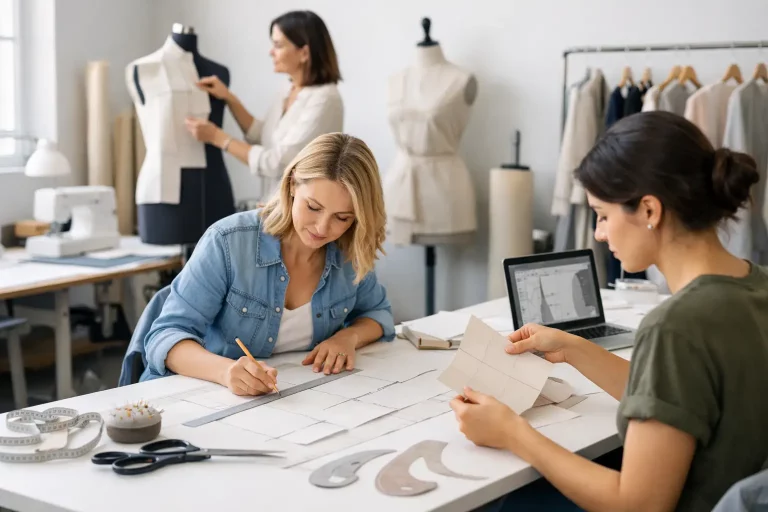
A design only becomes a viable garment when proportion, movement, and material come together in a functioning construction. Anyone who wants to learn how to create patterns therefore learns much more than just transferring lines onto paper: pattern drafting combines design idea, body measurements, sewing technique, and controllable fit.
It means to create sewing patterns.
A sewing pattern is the technical template for a piece of clothing. It defines which parts a garment consists of, how these parts are cut, and where they are sewn together. In addition to the shape, this includes seam allowances, grainline, notches, folds, darts, markings, and information on the material.
Professional pattern development doesn't start with a finished pattern, but with a clear question: What silhouette should be created? What freedom of movement does the garment need? Should it be close-fitting, loose or shaping? And how does the chosen fabric react to tension, weight, and processing? A woven blazer requires a different construction than a dress made of stretchy jersey. Pattern-making techniques must take these differences into account from the outset.
For professional qualification in fashion design and tailoring, this understanding is crucial. A visually impressive design is not enough if it cannot be precisely cut, sewn, fitted, and reproduced.
The Foundation: Measurements, Basic Patterns and Fit
Anyone who wants to learn how to create sewing patterns needs to start by getting comfortable with measurements. Body measurements are not abstract numbers. They describe volume, length ratios, and individual posture. Chest circumference, waist, hips, back length, shoulder width, and arm length form a basis, yet further control measurements are added depending on the model.
From these values, a basic pattern often arises. It is a constructive starting point for a specific product group, for example a bodice, skirt, trousers or sleeve. A basic pattern is not yet a design. It captures the body shape with the intended ease and can subsequently be modelled.
Mehrweite ist eine gestalterische und technische Entscheidung
Ease refers to the difference between a person’s body measurements and the garment’s measurements. It helps determine whether a garment allows freedom of movement, has a structured look, or drapes loosely. Too little ease can restrict movement and cause discomfort. Too much ease can detract from the intended silhouette.
There is no one-size-fits-all ease for every model. A shirt, a coat and a corset top follow different requirements. The material also changes the decision: a firm wool fabric needs structurally different solutions than a stretchy knit fabric.
The basic cut becomes the master pattern.
The seam variation translates the design into concrete pattern pieces. Darts can be repositioned, dividing seams developed, widths added or reduced, and collars, pockets, and fastenings constructed. From a basic bodice pattern, a figure-hugging dress with princess seams or a loosely cut blouse, for example, can be created.
It is important that every change is demonstrably justified. If a bust dart is moved to a division seam, the existing shape must continue to be controlled and incorporated. If a fold is planned, it requires sufficient ease. Pattern cutting is therefore not a case of trial and error without rules, but a system of shape, measurement, and processing.
Learning to create sewing patterns: a sensible workflow
A structured work process saves time and makes errors visible before valuable material is processed. In practice, a sequence of draft, construction, test model, and correction has proven effective.
First, the design idea is refined. A technical drawing helps to clearly capture the lines, lengths, type of fastening, and construction details. It answers questions that a free fashion sketch might leave open: Where does the dividing seam begin? How wide is the waistband? How is the sleeve set in? Which edge requires interfacing or facing?
This is followed by the pattern construction or the modification of a suitable basic pattern. The pattern pieces are then provided with all necessary markings. These include the grainline, fabric fold, sewing lines, seam allowances, notches, labels, and the number of pieces to be cut. If these details are missing, a pattern may have been drafted but is not reliably prepared for manufacturing.
A sample model is then made, often from a comparably priced, less expensive fabric. This model is not intended for final aesthetics, but rather for checking fit and construction. During the fitting, balance, seat, range of motion, and silhouette are assessed. If, for example, the front hemline lifts, the cause could be related to length, bust shape, or the distribution of ease. Creases at the armhole may indicate an ill-fitting sleeve cap or incorrect ease.
Only after correction will the edit be finalised. This loop is not a sign of a lack of ability. It is part of professional development. Good editing technique is not shown by everything fitting perfectly on the first attempt, but by deviations being professionally recognised and specifically corrected.
Why sewing and pattern cutting go hand in hand
A pattern cannot be judged in isolation from the sewing technique. The chosen finish influences the construction. A zip requires a suitable opening and stabilisation. A faced neckline needs facings or lining pieces. A French seam requires different seam allowances than an open overlocked seam.
Ironing techniques and interfacings also alter the outcome. A collar can be precisely constructed and still appear unstable if the interfacing doesn't suit the outer fabric or if the edges aren't carefully shaped. Conversely, a structural flaw cannot be compensated for by careful sewing alone.
That is why the combination of cutting technology, sewing technology and Materials science so valuable. Those who learn these areas together make more informed decisions and can guide a model from design to viable implementation.
Analogue or digital: Which method is right?
Patterns can be developed either traditionally on paper or using digital systems. Working in the analogue way provides an immediate understanding of angles, changes in shape, dart rotations and pattern logic. Particularly when you’re just starting out, it creates a solid foundation, as every line is deliberately constructed and checked.
Digital pattern-making, on the other hand, makes alterations, sizing adjustments, documentation and repeatability easier. It is particularly relevant when models need to be prepared in multiple sizes or production processes need to be structured. Nevertheless, software is no substitute for an understanding of fit. Anyone who fails to recognise why a pattern tilts at the shoulders or pulls at the hips will not be able to develop a convincing solution, even with digital tools.
Which method is more sensible depends on the objective. For custom tailoring, personal measurements and fittings are paramount. For a small collection or the establishment of a fashion brand, reproducible sizes, clear pattern documentation, and production-oriented processes also become relevant. In both cases, the fundamental expertise remains the same.
Typical errors and what they indicate about the level of learning
Many difficulties arise not from a lack of creativity, but from skipped checks. Those who apply seam allowances inconsistently, omit notches, or fail to consider grainlines make cutting and assembly more difficult. Those who work without a toile often only discover fitting problems in the final fabric.
Similarly, the properties of the fabric are often underestimated. A cut can appear balanced in cotton nettle and react completely differently in a heavy, soft-draping viscose fabric. Therefore, the sample material should be as close as possible to the later fabric in terms of weight, stretch, and drape.
A further learning step involves not only making corrections but also documenting them. Which seam was altered? How much length was added to the front piece? What effect does this have on the facing, lining or sleeve? This documentation makes progress visible and is valuable for portfolio development.
Expertise is gained through projects and feedback
Learning to create sewing patterns is most sustainably achieved with concrete models. A skirt conveys different principles than trousers, a sleeve different from a collar. As complexity increases, so do the demands on balance, shaping, and finishing.
Personal, professional guidance is particularly helpful in this regard. Feedback can distinguish between a symptom and its cause. A crease doesn't necessarily need to be corrected where it's visible. Often, the trigger lies elsewhere in the pattern or in the processing. This analytical perspective develops through repetition, fittings, and professional exchange.
A practical Fashion Design Further Education This is why it connects construction with real projects. At UniFash, sound pattern cutting, sewing techniques, and the comprehensible development of individual work are at the core. This way, individual exercises can gradually develop into a portfolio that showcases design decisions and technical expertise.
Frequently asked questions about learning to create sewing patterns
Is it possible to learn to create sewing patterns without prior experience?
Yes, if the learning path is structured systematically. It begins with measurements, simple basic shapes, cut marks, and fundamental sewing processes. More complex designs should only follow once the logic of fit, ease, and seam allowances has been understood. Previous experience can help, but it is less crucial than diligence, practice, and the willingness to accept corrections as part of the process.
How long does it take to get good at cutting your own hair?
This depends on prior knowledge, time commitment, and model complexity. Simple constructions can be understood sooner than a jacket with lining, collar, sleeves, and shaping darts. It's not just the number of patterns drawn that is crucial, but the quality of the evaluation after cutting, a sewing test, and fitting.
Do you need good drawing skills for pattern cutting?
When it comes to pattern-making, precision, spatial awareness and a methodical approach are more important than artistic drawing. Above all, a technical drawing must clearly convey how a model is constructed. Artistic drawing complements this skill, but is no substitute for pattern-making.
Anyone who seriously embarks on dressmaking develops not only a better cut with each controlled trial garment, but also a more precise understanding of the body, material, and craftsmanship.