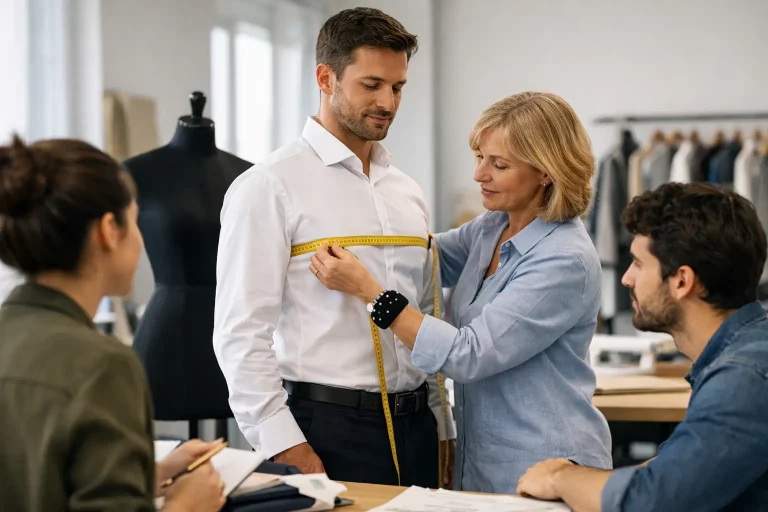
One sleeve pulls forward, even though the armscye is neatly worked. Trousers create folds under the buttocks, even though the side seam falls straight. Such fit problems often don't start with sewing, but with inaccurate body measurements. If Learning to take measurements for tailoring wants to learn more than just reading a measuring tape: It's about technically recognising posture, proportions and movement spaces and translating them into a viable pattern solution.
Why taking measurements is crucial in bespoke tailoring
Tailoring doesn't work with an abstract standard body. Every person brings individual characteristics: shoulders of different heights, a pronounced or flat back line, a changed waist position, postural influences, or special length proportions. Taking measurements creates the basis for comprehensibly recording these characteristics.
It is not enough to simply record chest, waist, and hip measurements. A professional set of measurements combines circumference, length, and control measurements. Only their interplay shows whether a basic pattern needs to be adjusted and where width, length, or balance should be changed. The craft skill lies in not viewing measurements in isolation, but in reading them as a picture of a real body.
This is particularly relevant for custom-made clothing, sample pieces, fittings, and the development of your own fashion brand. Those who construct or adapt patterns can only reliably assess the fit if measurements are collected, documented, and later compared with the garment in a precise manner.
Correct preparation before measuring
Professional measurements begin with calm, clear preparation. The person stands upright but relaxed. An artificially corrected posture distorts the measurements, as does a puffed-out chest or a tucked-in stomach. Measurements are taken over close-fitting clothing or underwear, depending on the final product and company standards.
A high-quality measuring tape should be flexible, dimensionally stable and easy to read. In addition, a waist band, a measurement chart, a pen and, if necessary, mirrors and a camera for posture observation are helpful. The waist band marks the natural waistline and prevents length measurements from deviating from changing reference points during measurement.
Before the first number is the observation. How are the shoulder line and back? Is the hip straight or unevenly developed to the side? Does one shoulder stand further forward? These impressions are not a diagnosis and do not replace measurements. However, they help to record peculiarities and to check them specifically during pattern adjustment.
Taking measurements for bespoke tailoring: The most important measurement groups
A complete set of measurements always takes into account the type of garment, the cutting system, and the desired silhouette. Different specifications are needed for a shirt, a jacket, or trousers. Nevertheless, the central measurements can be organised into three groups.
Measure circumferences correctly
Circumference measurements such as bust, waist, hip, neck, upper arm, or thigh width are taken horizontally to the body's axis. The tape measure should lie flat but not dig in. Loosely measured circumferences will result in unnecessary extra width later; measurements taken too tightly will lead to a cut that restricts movement and wearing comfort.
The measuring height is important. The chest width is measured at the widest point, and the hip width at the widest part of the hips or buttocks. Especially with different body shapes, it can be advisable to take additional check measurements. These help to adjust the distribution of width in the pattern in a differentiated way, instead of just increasing or decreasing the overall circumference.
Take length measurements with clear reference points
Length measurements describe the proportions of the body. These include, for example, back length, front length, side length, sleeve length, inside leg length, or the length from the base of the neck to the bust. It is crucial to always measure from clearly defined points.
For example, the back waist can be significantly different from the front waist. If both areas are treated with a single standard measurement, a top can ride up at the back or appear too long at the front. Good measurement makes such differences visible. It thus provides the basis for a balanced front and back section balance.
Include control measurements and posture
Check control measurements to see if a cut fits the person both mathematically and visually. This can include shoulder width, chest depth, back width, arm length to the wrist, or seat height for trousers. They are particularly valuable when measurements vary noticeably or when a fitting later indicates balance errors.
Postural stance isn't about pigeonholing people. It's about the objective question of how the body carries a garment. A forward-leaning posture, for example, changes the required back length and shoulder position. Precise observation supports pattern cutting technique, but it never replaces fitting on the model.
From numbers to seam adjustment
A pattern sheet is not yet a garment. The next step is to connect the measurements with a basic pattern or individual drafting. This is where the difference between mere measuring and professional bespoke tailoring.
Let's consider a top with a large difference between the bust and waist measurements. The extra width must be incorporated into the design, for example, using darts, dividing seams, or a different cut. If there's a significant shoulder difference, the shoulder line may need to be adjusted. The best solution depends on the design, material, need for movement, and the desired silhouette.
The choice of fabric also changes the assessment. A Firm wool fabric reacts differently to an elastic jersey or a flowing viscose fabric. While measurements remain the basis, ease and construction must suit the material. Therefore, tailoring always requires the interplay of pattern cutting, sewing techniques, material science, and fittings.
Common measuring mistakes
Many errors arise not from a lack of diligence, but from a lack of systematic approach. A measuring tape is held at an angle, a person unknowingly changes their posture, or a value is recorded without a reference point. Such deviations seem small, but they add up on average.
Another common mistake is mixing up body measurements and finished garment measurements. Body measurements describe the body, while finished garment measurements describe the final piece of clothing, including necessary ease. If these two are not kept separate, it's impossible to plan fit or ease of movement in a comprehensible way.
It is equally problematic to forgo a fitting. Even meticulously taken measurements cannot anticipate every effect of a fabric, a construction, or an individual posture. A fitting is therefore not a sign that work was done incorrectly. It is a professional inspection step where measurement, pattern, and workmanship come together.
This is how security develops in practice
Taking measurements improves with repetition, but not with repetition alone. The professional assessment is crucial: was the measurement taken in the right place? Does the cut change match the observed feature? How is the decision reflected in the fitting? Those who document these questions will develop a reliable understanding of fit more quickly.
It is sensible to work with clear basic models, such as a skirt, trousers, and a top. Different measurement groups and corrections can be practiced understandably on these. A structured measurement sheet, photos of the fitting with the consent of the person concerned, and precise notes create a valuable working basis for portfolio development.
In a practice-oriented fashion design further education course, taking measurements is therefore not relegated to the sidelines of the curriculum. It is directly linked to pattern cutting, manufacturing, and design decisions. Personal professional guidance is particularly helpful because it not only checks measurements but also explains their impact on the pattern and the garment.
Who it's particularly worthwhile for
In-depth knowledge of taking measurements is just as relevant for aspiring bespoke tailors as it is for people in the career reorientation, for cutting technicians, designers and founders of small fashion labels. They create a professional foundation to more competently assess individual customer orders, pattern development and fit corrections.
The appropriate learning path depends on your goal. Those who wish to develop professional custom-made garments need a particularly deep understanding of body measurements, pattern construction, and fitting. Those who primarily work in fashion design should still have a confident command of taking measurements, in order to be able to constructively implement designs and to conduct informed communication with pattern cutting and production.
UniFash provides a practical approach to craftsmanship within premium fashion education, rather than teaching it in isolation of its application. Taking measurements becomes tangible when a pattern is created from a spec sheet, and from that pattern, a garment is made, whose fit can be demonstrably assessed.
Frequently asked questions about taking measurements
How many fittings should be done for a bespoke garment?
At least one full measurement set is necessary. Depending on the garment, lead time, and any issues during the fitting, a check measurement may be beneficial. It is often helpful for close-fitting or specially constructed models.
Can you learn measuring digitally?
Theoretical foundations, measurement sheets and seam connections can be well developed digitally. For professional safety, practical practice on people, feedback on handling and measurement progress, as well as the evaluation of real fittings are also necessary.
Are standard sizes sufficient as a basis?
Standard sizes offer an important starting point for industrial tailoring and basic patterns. However, they are insufficient for bespoke clothing as they only allow for limited representation of individual proportions, posture, and desired ease.
Precise measurement is not a secondary task before the actual design. It is the moment when creative idea and craftsmanship reality are connected – and herein lies the quality of a perfectly fitting piece of work.