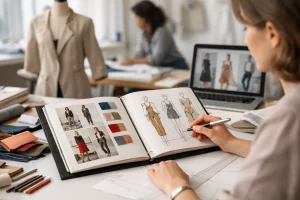

A sketch can convey a strong idea – but only an understandable fashion illustration turns it into an actionable design statement. Who Learn fashion illustration online therefore needs more than templates to trace. Crucial are a trained eye for proportions, a confident handling of silhouette and details, as well as expert feedback that links the drawing with cutting techniques, materials, and later realisation.
For vocational training in fashion design, fashion illustration is not an isolated subject. It is a working tool: for collections, technical specifications, presentations, and personal portfolio development. Learning digitally can be very effective if the lessons are clearly structured and practical exercises are consistently supported.
What constitutes professional fashion illustration
Fashion drawing, frequently also called fashion illustration, does not simply depict a clothed figure. It translates a design into a visual language. The emphasis here is not on anatomically realistic representation, but on the convincing communication of a look's cut, volume, drape, and character.
A fashion figure is usually elongated in proportion so that the silhouette and clothing remain clearly legible. This is not a fixed rule. Depending on the design intention, a dynamic, sketchy figure can be more useful than a carefully detailed representation. However, for a professional portfolio, it should always be clear how the garment is constructed: Where is the shoulder? How does the waistline run? How wide is the skirt? What details influence the construction?
This is where the difference between decorative drawing and professional fashion illustration lies. A beautifully coloured design remains incomplete if the collar, sleeves, seams or material properties are unclear. Conversely, a simplified drawing can be very convincing if it clearly shows a specific design decision.
Learning pattern drawing online: these fundamentals count
A sensible online learning path begins with proportion and posture. First, the fashion croquis is developed – that is, the stylised basic figure on which different designs are created. Those who understand this foundation can vary poses without the clothing and body losing their spatial logic.
After this comes the silhouette. It is often the first thing viewers notice: narrow or wide, close-fitting or sculptural, short or floor-length, softly falling or constructed. Beginners, in particular, often draw details too early. It is more professional to first clarify the overall form and only then add details like necklines, fastenings, pockets, or embellishments.
Another core area is the depiction of fabric. Denim behaves differently to silk, wool cloth differently to jersey, organza differently to leather. Folds therefore are not arbitrary lines. They arise from tension, support, movement, and material weight. A good exercise is to first sketch a garment as only a silhouette and then to render it in several variations: once in flowing viscose jersey, once in firm cotton poplin, and once in a heavy suiting fabric. This makes visible how material changes a design.
Colour also needs a design function. It can convey colour concepts, contrasts and values, but should not conceal the construction. To begin with, greys, a purposefully placed accent and clear material indications are often sufficient. Only when form and proportion are securely established is more elaborate colouring worthwhile.
From sketch to actionable design drawing
Professional fashion drawing moves between creative freedom and technical accuracy. A concept sketch can be spontaneous and show the mood of a collection. However, further information is needed for the development of a model: front and back views, visible seam lines, types of fastenings, pocket shapes, material ideas, and, if necessary, detail views.
Therefore, professional fashion education must also include an understanding of pattern cutting and sewing techniques. Those who know how a raglan sleeve is constructed or how the placement of a dart affects the shape will design with greater awareness. The drawing becomes more realistic without sacrificing creativity. At the same time, design decisions can be tested earlier: Is the desired shape feasible with the intended material? Does the model require interlinings, lining, or special finishing steps? Where are the technical limitations?
This doesn't mean every drawing has to be production-ready straight away. Design work thrives on research, variations, and corrections. However, the earlier design ideas and technical feasibility are considered together, the more robust a portfolio will become.
How to succeed with digital learning
Digital teaching offers temporal flexibility and the opportunity to revisit steps. However, this alone does not replace professional guidance. Those learning online should not just watch videos but regularly create, submit, and revise their own drawings.
A viable learning rhythm links input and application. Following a unit on proportions, a series of figures should directly ensue. After a topic on fabric drape, a concrete material study is advisable. Instead of producing many unfinished sketches daily, it is more beneficial to consciously analyse a few drawings and visibly develop them further.
Qualified feedback is particularly valuable. It should not stop at statements like „more contrast“ or „draw more beautifully.“ Concrete pointers are helpful: the shoulder line is too wide, the hem length gets lost behind the leg, the direction of the folds doesn't match the axis of movement, or the sleeve doesn't appear connected to the arm's posture. Such feedback creates understandable next steps.
At UniFash, digital learning is therefore combined with personal professional support, practical projects, and portfolio development. For people in the career reorientation Is this connection particularly relevant: You don't just learn a presentation technique, but you also develop work samples that demonstrably show your design and practical skills.
Analog, digital, or a combination?
Whether working with pencil, markers, gouache, or tablet, it depends on the objective, prior experience, and desired aesthetic. Analog techniques train observation, line control, and a feel for materials very directly. They are particularly suitable for understanding form, shadow, and paint application.
Digital tools, on the other hand, simplify corrections, variations, and preparation for presentations. Layers, for example, help to edit figures, clothing, patterns, and shading separately. This can speed up processes, but it also has a disadvantage: those who rely too early on effects, brush tips, or ready-made templates easily overlook the fundamentals of drawing.
For most aspiring fashion designers, a combined approach is sensible. Confident hand-drawing forms the foundation. Digital editing can subsequently be used for elaboration, colouring and portfolio presentation. The tool is not decisive, but whether the drawing clearly conveys an idea.
A beginner's workout plan
A structured introduction can be organised around four progressive focal points:
- Week 1: Drawing basic shapes, axes, proportions, and simple standing poses.
- Week 2: Develop silhouettes and vary a model in several lengths or widths.
- Week 3: Create material studies on folds, gloss, transparency and volume.
- Week 4: Develop a complete look with front and rear views, colour ideas and detail notes.
This process is not a substitute for professional training, but it provides a good orientation. It is important not only to start new content each week but also to revise at least one drawing. Comparing the first and corrected versions makes learning progress visible and trains the ability for self-reflection.
What a fashion design portfolio should look out for
A portfolio doesn't need to showcase as many styles as possible. A comprehensible selection that demonstrates development and working methods is more meaningful. This can include research images, colour and material ideas, croquis variations, developed looks, and technical additions.
Quality arises from clarity. Ten consistently developed designs are usually more convincing than thirty inconsistent pages. Pay attention to a calm design, legible drawings, and a recognisable connection between inspiration, design, and possible implementation. If sections, sewing samples, or manufactured models are available, these can usefully complement the design drawing.
Quite often with applications for a Fashion Design Further Education or in the case of a career change the portfolio Don't pretend to be perfect. It's okay to show where you currently stand. What's crucial is that your artistic attitude, your learning potential, and your willingness for precise further development become evident.
Frequently Asked Questions about Online Fashion Design
Do I need any prior knowledge?
No, perfect drawing skills are not required for getting started. Patience, regular practice, and an interest in clothing, proportions, and materials are helpful. Those who already draw will benefit, but they often need to learn to focus freehand illustration more on fashion, construction, and silhouette.
How much time should I allow?
That depends on the starting point and the goal. Regular, focused sessions lead further than infrequent long workdays. Sustainable progress requires time for drawing, revising and processing feedback. For professional qualification, there is also the connection with cutting techniques, sewing techniques and project work.
Is fashion illustration sufficient for starting a career?
Fashion design is a core skill, but not a complete professional qualification. Depending on the desired field of activity, knowledge in pattern cutting, manufacturing, materials science, digital design, collection development, and presentation is also expected. A sound fashion education connects these areas rather than separating them.
A compelling fashion drawing doesn't start with a particularly expensive pen or a fancy app. It starts with a precise question: What shape should this garment have, what material should it appear to be made of, and how can I show that in a way that others will understand the idea? Anyone who takes this question seriously with every exercise will develop a visual language with professional substance step by step.