A folder with beautiful illustrations can attract attention. However, it is rarely enough on its own for an application, a fashion design further education course, or building your own brand. Whoever wants to Create a fashion design portfolio wants to show how an idea becomes a viable garment: through research, design, pattern cutting techniques, material selection, and craftsmanship.
A professional portfolio is therefore not a collection of your favourite pictures. It is a comprehensible selection of projects that demonstrates your design style and your professional working methods. Especially for career changers and people in the career reorientation Is this clarity valuable: It's not a perfect CV that's at the forefront, but what you can develop and implement.
What a good fashion design portfolio must achieve
A portfolio answers four questions for viewers: What are you good at? How do you develop ideas? What technical skills do you bring? And how consistently can you realise a project?
The weighting depends on the objective. For a design-oriented application, silhouette, concept, and visual language may take greater precedence. If you are Qualification in cutting techniques, If you are aiming for a career in sewing techniques or tailoring, you should also demonstrate precise construction and finishing details. For your own fashion brand, target audience, product logic, and the feasibility of a collection are also relevant.
A compelling portfolio doesn't need to be extensive. Often, four to six carefully documented projects are stronger than twenty loose sketches. The crucial point is that each project has a discernible statement to make, and the selection as a whole conveys a clear profile.
Creating a fashion design portfolio: with a clear common thread
Before designing pages, establish the framework. In two or three sentences, articulate what kind of fashion interests you and what attitude shapes your work. This could be, for example, a focus on precise tailoring silhouettes, functional everyday wear, experimental volumes, or material-driven designs.
This common thread does not mean that all works must look the same. Rather, it helps you to make a comprehensible selection. A portfolio becomes more credible if the projects demonstrate different skills, yet still display a common design language.
Start with your strongest and most impactful project. The first few pages will determine whether someone continues to browse. A weak or incomplete project shouldn't be in your portfolio just because it took a lot of work to produce. Portfolio development also requires the ability to select consciously.
The sensible structure of a project stage
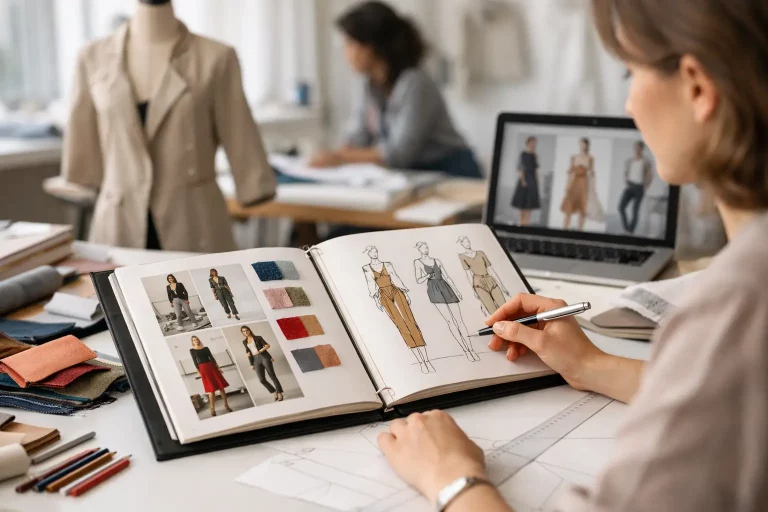
Each project should function like a short visual argument. First, present the initial idea: research images, observations, material samples, or a clearly formulated impulse. This should be followed by sketches and silhouette development. Subsequently, document the selection and implementation with technical drawings, cross-sections, interim fittings, and meaningful photos of the finished look.
Not every page needs all the steps. In one project, material development might be particularly relevant, while in another, the construction of a collar or the fit of a blazer. It's important that the images don't just look decorative but explain your decisions.
Short captions are helpful. Name things like material, manufacturing technique, size of the model shown, or your specific task in the project. Avoid long blocks of text. A portfolio is primarily read visually and should still remain technically unambiguous.
These contents demonstrate expertise
Style arises at the intersection of design and craft. A portfolio should showcase both aspects, even if your strengths initially lie more in design or more in execution. Particularly when it comes to professional development, it's advisable to openly demonstrate your potential for growth, rather than just hinting at your technical skills.
Particularly significant are:
- Moodboards and research that go beyond purely inspirational images
- Hand-drawn sketches or digital designs with discernible silhouette development
- Technical drawings with front and rear views
- Pattern cutting, draping or marked adjustments to the bust
- Material samples with details on case, handle and intended use
- Photos of fabric samples, details, and fittings
- professional or carefully staged images of the final outfit
You do.
If you have created work as part of a team, please precisely indicate your role. Did you develop the design, construct the pattern, sew it, or handle the styling? Transparency appears professional and prevents misunderstandings.
Image quality: precise rather than elaborate
You don't need a large photoshoot to create a good portfolio. You need light, order, and an eye for the essentials. Photograph clothing items, where possible, against a calm background, in even light, and from clear perspectives. Show overall views as well as details, such as hems, fastenings, sleeve attachments, or lining finishes.
Ensure the look is well-fitted and the model is properly prepared. Loose threads, wrinkled fabrics, or distracting backgrounds will detract from the work. The same applies to sketches, pattern drawings, and material pages: align them straight, light them well, and label them legibly.
Digital illustrations can be a supplement, but do not automatically replace practical implementation. Anyone who exclusively shows renderings primarily demonstrates conceptual and digital skills. For positions or educational paths with a practical focus, realised models, sample parts, and processing samples gain significant importance.
Format, scope and design
A digital PDF is the appropriate basic format for many application and consultation situations. It can be read in a structured way, is easy to send, and preserves your page order. A file of about 15 to 25 pages usually offers enough space for several projects without being overwhelming. For a discussion, you can additionally prepare individual original samples or a small material booklet.
Choose a quiet layout with recurring margins, font sizes, and image formats. The design may support your aesthetic stance, but should never compete with the works. Very decorative backgrounds, changing fonts and cluttered collages make assessment difficult.
A brief landing page with your name, contact details, area of specialisation and, if applicable, a portrait, provides an overview. Projects follow this. At the end, there can be a concise page with technical competencies, such as cut techniques, sewing techniques, Adobe programmes or draped designs. Only list skills that you can classify based on your work or explain in conversation.
Common mistakes in portfolio development
The most common mistake is a portfolio lacking a discernible selection. Lots of pictures don't automatically mean lots of competence. Cut out repetitions and ask yourself on every page: Does it show something new about my working methods?
The gap between design and result is also problematic. A strong illustration is more convincing when it is complemented by a technical drawing, a detail or a photo of the implementation. Conversely, a well-sewn item needs a brief design context so that the decision behind it becomes clear.
Perfectionism can also hinder progress. A portfolio may show development. If a project is not yet fully mature, a well-documented revision or a considered adjustment can be valuable. The crucial point is that you do not present something unfinished as final.
FAQ: Fashion Design Portfolio
Do I need any pre-made garments?
Not necessarily for every project. However, for a practice-oriented portfolio, realised models, details or sewing samples are a clear advantage. If you are just starting out, you can also show a small, carefully executed capsule or individual constructively interesting parts.
Can I create a portfolio without prior experience?
Yes. Start with manageable tasks, like a skirt, a blouse, or a clearly developed mini-collection. It’s important to make the journey from idea to implementation visible. Professional guidance can help in sensibly selecting and constructively developing projects.
Should I mix analogue and digital work?
Yes, if the mix is understandable. Hand drawings, material experiments, and digital technical drawings can complement each other meaningfully. The decisive factor isn't the tool, but the quality of your design and craft decisions.
A portfolio evolves with you. After each project, check which skill it proves and which gap remains. This way, a portfolio gradually becomes a credible testament to your personal development, your professional competence, and your direction in fashion design.