
Analyse von Trends und Zielgruppen
Trends, culture, society, materials, competition, customer groups, and market requirements are observed and evaluated.
What does a fashion designer do in their day-to-day work? This guide explains tasks, workflows, required skills, portfolios, employment fields, self-employment, and possible educational paths into the fashion industry.
Fashion designers develop clothing, individual pieces or complete collections. They translate social trends, brand identities, target group needs and creative ideas into concrete clothing designs.
The work often begins with research, concept development, and initial sketches. This is followed by the selection of colours, fabrics, silhouettes, details, and finishing. Technical drawings, sample pieces, and documentation for further production are then created from selected designs.
Depending on the company, the profession can be strongly creative, technical, production-oriented, or commercially focused. Not every fashion designer sews all their garments themselves. However, a fundamental understanding of pattern cutting, materials, fit, and craftsmanship remains particularly valuable.
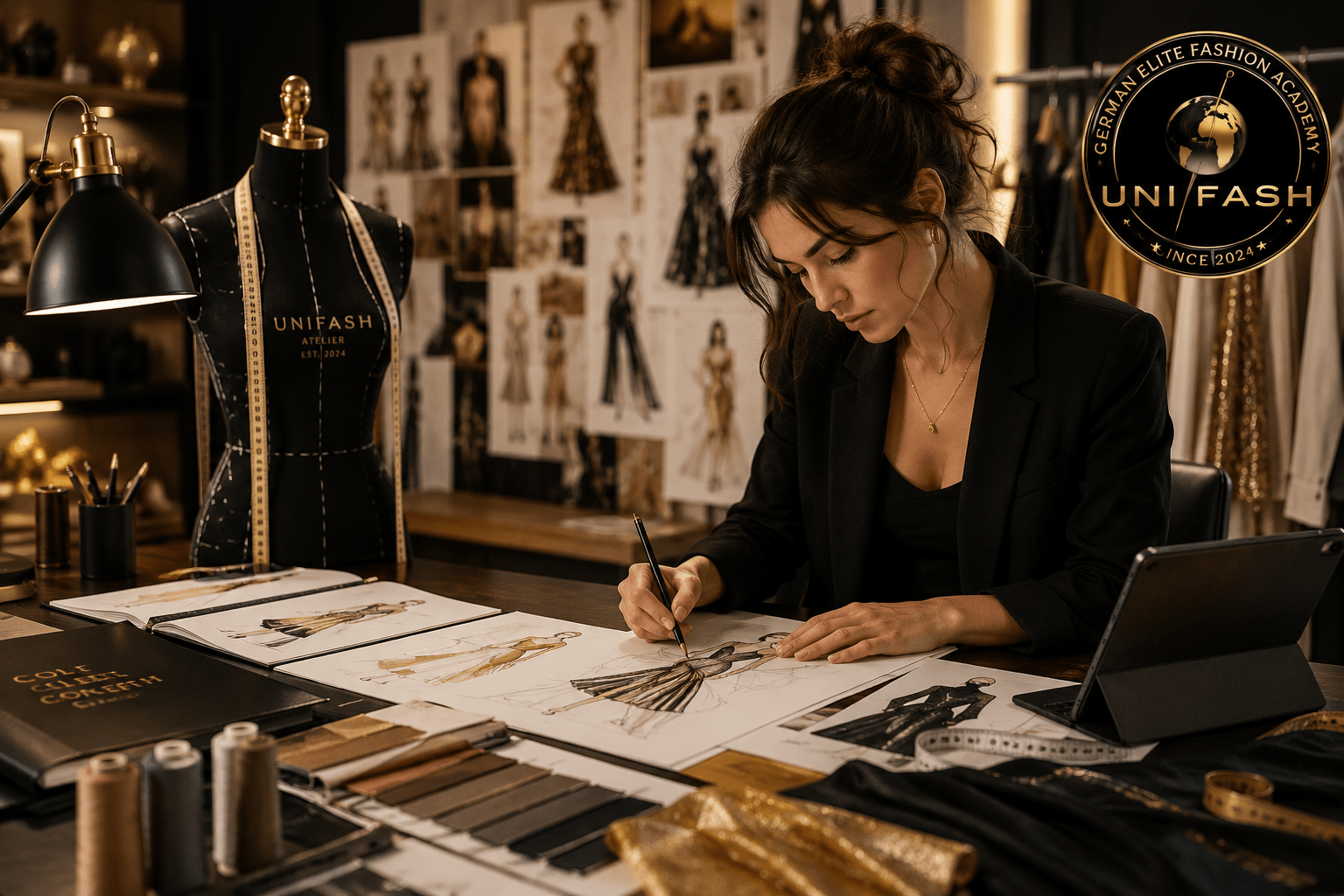
Trends, culture, society, materials, competition, customer groups, and market requirements are observed and evaluated.
Research gives rise to themes, mood boards, colour palettes, silhouettes, material concepts, and design guidelines.
Ideas are communicated through hand sketches, digital drawings, figurines, or other visual representations.
The fall, weight, feel, colour, function, price and manufacturing characteristics must match the design.
Front and rear views, seams, pockets, closures, and important construction details are clearly shown.
Sample garments are assessed, fit and proportion are checked, and necessary alterations are documented.
Designers work with Schnitt (cutting), product development, purchasing, the studio, production, and marketing, among others.
Designs and samples are presented internally, to clients, in sales, or as part of presentations.
Designs are adapted to price, target audience, fit, material availability, and production conditions.
The concrete process differs between couture ateliers, fashion companies, retail brands, and independent studios. However, a typical development process can be broken down into several steps.
The job title can encompass very different tasks within companies. Some positions are heavily design-oriented, while others are closer to product development, engineering, or production.
| Field of work | Possible focus | Typical tasks |
|---|---|---|
| Fashion company | Collection development | Designs, colour concepts, materials, line-up and coordination with product development |
| Atelier or couture | Bespoke and Special Collections | Design, material selection, fittings and close collaboration with pattern cutting and tailoring |
| Brand name | Target group and market-oriented products | Market analysis, design, price framework, supplier selection, and assortment coordination |
| Product Development | Technical and economic implementation | Prototypes, material release, fit, technical documentation, and production communication |
| Costume and Stage | Figure, Epoch and Staging Reference | Costume design, material research, adaptation to movement and collaboration with workshops |
| Own label | Design and Business Management | Collection, brand, purchasing, costing, sales, marketing and customer communication |
| Freelance Design | Project-related orders | Designs, mood boards, illustrations, technical drawings or collection pieces for clients |
Professional fashion is almost never created in isolation. Depending on the size of the company, designers work alongside various specialist departments.
Translate designs into pattern pieces; check the fit, proportions and technical feasibility.
Produce patterns, toile models, or one-off pieces and provide important feedback on the manufacturing process.
Check availability, price, minimum order quantities, delivery times and quality of fabrics and accessories.
Coordinates appointments, suppliers, technical documentation, production steps, and quality requirements.
Information regarding target audience, collection, materials, and design history of the products is required.
Defines the overarching brand and visual language and aligns collections with the overall identity.
A portfolio doesn't just show pretty end results. It should make visible how you research, design, make technical decisions and develop a project further.
Theme, Target Audience, Inspiration Sources, Moodboards and the Development of the Design Direction.
Initial ideas, variations, form studies, discarded approaches, and justifiable selection decisions.
Carefully crafted looks, silhouettes, colour palettes, materials and styling ideas.
Clear front and back views with details, seams, fastenings and construction elements.
Cuts, toile models, prototypes, fitting corrections and finished garments.
Thoughtful sequence, readable design, clear texts, and a discernible personal stance.
Designs are rarely implemented unchanged. Fit, cost, materials, and target audience regularly require adjustments.
Collections, trend dates, production and presentations follow clear schedules.
A creative design must often work within a set price and production framework.
An idea must be documented in such a way that other specialists can reliably implement it.
A compelling portfolio, practical experience, and clear professional positioning are particularly important.
Materials, digital tools, production techniques and industry demands are changing.
There isn't just one single route into fashion design. The right educational path depends on your desired qualification, age, prior experience, available time, and career goals.
A vocational training can combine creative and technical fundamentals and lead to a school-based or state-recognised qualification.
Compare training pathwaysA degree course offers an academic engagement with design, creation, theory, projects, and potential economic topics.
This path is particularly suitable for individuals who wish to delve deeper into cutting, fitting, tailoring, and custom garment construction.
Practical further training, portfolio work, personal projects, and professional experience can support an alternative entry.
Path without study seenThe UniFash further education course combines fashion design, pattern cutting, sewing techniques, and tailoring over six months and 720 teaching units.
View UniFash Further EducationFor self-funded individuals, a flexible model without a fixed daily full-time structure may be suitable. Material costs are borne by the individual.
View self-pay optionThe answers help to realistically assess the job profile and entry points.
Possible tasks include research, sketches, collection development, material selection, technical drawings, sample reviews, fit checks, presentations, and coordination with other departments.
Not every professional position requires you to sew all garments yourself. However, a good understanding of craftsmanship, materials, cut, and fit makes design, communication, and quality control easier.
Drawings must communicate ideas clearly. Artistic perfection is not crucial in every field of work, but sketches, technical drawings and digital representations should be easily readable.
A degree is one possible path, but not the only one. Vocational training, practical experience, further education, portfolio work, and hands-on projects can also build important skills.
A portfolio should showcase research, design development, fashion illustrations, technical drawings, material concepts, practical work, and understandable project processes.
Yes. Options include your own label, a studio, or freelance design services. In addition to design, costing, sales, organisation, and customer acquisition are then required.
No. UniFash offers professional training in fashion design and tailoring. It is neither a vocational school education nor a university degree.
Deepen your career entry, compare educational paths or find out about the specific UniFash further training.
Alternative routes via practice, further training, portfolio, and specialisation.
Educational pathways Fashion Design Education ComparisonSchool education, university studies, crafts, and further training differ.
Design process Learn Fashion DesignResearch, Moodboard, Material Concept, Collection and Portfolio.
Basics Learn fashion designFashion drawing, sewing,.
Expertise Learn cutting techniquesUnderstand basic patterns, pattern alterations, measurements and fit.
Further training in Fashion Design and Bespoke TailoringCentral course page for the six-month advanced training with 720 teaching units.