
Anyone who wants to work professionally in fashion, pattern cutting and manufacturing needs more than creative flair. Crucial are manual.
The Partial qualification in bespoke tailoring The UniFash | German Elite Fashion Academy creates a new educational path for this. The six-month, hybrid further education programme combines digitally conveyed specialist knowledge with extensive practical tasks and personal professional support. The special feature: The curriculum was developed to the Chamber of Crafts for Lower Franconia submitted and examined with regard to the contents of the first eighteen months of vocational training in the bespoke tailoring trade. Participants in UniFash will be admitted to the external interim examination on this basis. Participation in the examination is voluntary. Those who decide to take the examination and successfully pass it will receive an official interim examination certificate from the Chamber of Crafts.
The most important things at a glance
- Duration of further training: six months
- Learning format: blended further education
- Focus: Fashion Design and Bespoke Tailoring
- Funding: Education voucher possible
- Training provider: AZAV-certified
- Curriculum: professionally assessed by the Chamber of Crafts for Lower Franconia
- Examination procedure: voluntary external interim examination
- Examining body: competent Chamber of Crafts or Guild
- Proof of passing: official intermediate examination certificate
- First exam participation: September 2026
What does partial qualification mean in the bespoke tailoring trade?
A partial qualification imparts professionally relevant skills from a recognised occupational profile. It is particularly interesting for.
Reviewed by the Chamber of Skilled Trades for Lower Franconia
A crucial difference compared to many general sewing or fashion courses lies in the professional classification of the curriculum. UniFash has its curriculum classified as Chamber of Crafts for Lower Franconia submitted. It was examined whether the content conveyed meets the professional requirements of the first eighteen months of training in the recognised vocational occupation of bespoke tailor (male or female). On this basis, the Chamber of Crafts accepts UniFash participants for the external intermediate examination. For those who are interested, this curriculum review creates additional transparency. The competencies conveyed are not only based on freely chosen course content but on the specific professional requirements of the bespoke tailoring trade. UniFash thus combines the flexibility of modern further training with a clear orientation towards the quality standards of German craftsmanship.
Voluntary external intermediate examination in bespoke tailoring
Participation in the external interim examination is not a compulsory part of the further training. Each participant decides for themselves whether to make use of this additional examination route. The examination is not conducted by UniFash. It takes place before the responsible Chamber of Crafts or Guild and is carried out by an independent examination commission. Those who successfully pass the interim examination will receive the official interim examination certificate from the Chamber of Crafts. This proof documents that the examined professional and practical achievements have been successfully demonstrated. It can be of particular additional value for applications, in discussions with employers, or for further career planning. However, the interim examination is not equivalent to the journeyman's examination. The journeyman's certificate requires an additional and legally regulated examination process.
The first UniFash candidates will take their exams in September 2026
In September 2026, the first participants of UniFash will sit their external interim examination before the responsible guild. For UniFash, this is an important milestone. It shows that hybrid further training in the tailoring trade does not have to end with theoretical knowledge or internal participation certificates. Participants can voluntarily demonstrate their acquired skills before an external trade examination board. This approach is particularly exceptional for a hybrid qualification measure. The tailoring trade is traditionally strongly associated with exclusively company-based or school-based in-person tuition. The UniFash concept complements these established forms of education with flexible access for adults. The first examinations in September 2026 will therefore also serve as a practical test for a new approach in vocational further training.
Why hybrid education can work in the tailoring trade
Tailoring cannot be learned solely through reading or watching videos. Craftsmanship is developed through practical repetition, careful observation, corrections, and the continuous improvement of one's own work. A high-quality hybrid concept must therefore consistently combine digital knowledge transfer with practical application. At UniFash, theoretical basics, pattern making, construction techniques, and workflows are taught digitally. Participants then practically apply this content through specific exercises and clothing projects. The completed work, pattern making, and individual work steps are professionally supervised. Feedback helps to identify errors, improve construction techniques, and further develop one's own working methods. The hybrid model offers several advantages as a result:
- Learning regardless of location
- Clear and structured learning content
- repeatable digital demonstrations
- extensive practical tasks
- Personal professional feedback
- Independent planning of practical work phases
- Setting up a professional work routine
Flexibility does not mean reducing the academic standard. Participants must apply their knowledge practically and demonstrate it through their own work results.
What skills are taught?
The advanced training covers key areas of fashion design and tailoring. It is not just about individual sewing techniques, but about the interplay of design, construction, material, craftsmanship and fit.
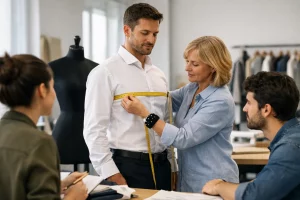
Professional measuring
Accurate body measurements form the basis for a perfectly fitting pattern construction. Participants will learn to professionally record, document, and use relevant measurements for further pattern construction. Even small measurement errors can later lead to significant fit problems. Therefore, accuracy, a standardised measurement method, and an understanding of body proportions are among the fundamental competencies.
Pattern cutting
In pattern cutting, two-dimensional pattern pieces are developed for three-dimensional body shapes. Participants will learn to construct basic patterns and adapt them to different styles. This includes, among other things, skirt and.
Sewing techniques and finishing
Professional sewing techniques go far beyond simply stitching individual fabric pieces together. Different materials, garments, and constructions each require appropriate finishing solutions. This course covers, among other things, neat seam finishes, the correct handling of machines and tools, and the planned sequence of individual work steps.
Materials science
Fabrics differ in terms of weight, drape, elasticity, surface and processing behaviour. These properties influence design, pattern cutting and manufacturing. Participants will learn to assess materials and select them appropriately for a planned garment.
Fit analysis and corrections
A pattern can be technically correct and.
Model Development
Based on basic patterns, original models are developed. Design ideas must be implemented in such a way that a technically functioning and wearable item of clothing is created. Model development combines creativity with constructive thinking and practical craftsmanship.
Manufacture of complete garments
Craftsmanship is particularly evident in the complete manufacturing process. Therefore, several practical assignments and garments are created during the further training. These include, among other things, different skirt styles, a business pair of trousers, and further projects that bring together pattern construction, cutting, processing, and quality control.
Portfolio development
A professional portfolio does not just document finished results. It also shows sketches, technical drawings, pattern developments, material choices, and individual work steps. This allows participants to credibly present their creative and craft skills.
Who is the partial qualification suitable for?
The professional development course is aimed at adults with diverse professional and personal backgrounds. It may be particularly suitable for:
- Career changers
- Jobseekers
- People undergoing a career change
- Career returners
- Individuals with education vouchers
- Graduates of domestic science schools
- People with first-hand sewing experience
- Creative talents with professional goals
- Those interested in the tailoring trade
- People who wish to design and create fashion professionally
Crucial are a willingness to learn, accuracy, and a readiness to regularly practise practical skills. Fashion tailoring requires patience. Not every step succeeds on the first attempt, and professional corrections are naturally part of the learning process.
Further training with an education voucher
This training programme is certified as an AZAV measure. Provided the personal eligibility criteria are met, funding may be available via a training voucher from the Employment Agency or the Jobcentre. A training voucher may, amongst other things, cover the course fees. Participants admitted via the funded programme will also be provided with the learning and work materials intended for the programme. The relevant Employment Agency or Jobcentre will decide whether to grant an education voucher based on the individual’s professional situation. Those interested should be able to explain during the advisory meeting what their career goals are and how the further training can improve their employment prospects. The programme number for the further training course is 759/170/25.
What career prospects arise?
Further training alone does not guarantee specific employment. However, it can impart skills that are needed in various areas of the fashion, clothing, and textile industries. Possible fields of activity include, for example:
- Bespoke tailoring
- Tailors
- Fashion workshops
- Bridal and formal wear boutiques
- Costume departments
- Theatre and Opera
- Film and media productions
- Sample production
- Clothing company
- textile workshops
- own fashion projects
- Preparatory steps to self-employment
Which professional perspective is realistic depends on individual skills, practical work results, previous experience, and the regional labour market. A portfolio and a successfully completed interim examination certificate can help to demonstrate acquired competencies to potential employers in a comprehensible way.
Partial qualification, further training and apprenticeships compared
The terms 'Teilqualifizierung'.
Quality over quick promises
The craft of bespoke tailoring cannot be fully mastered in just a few weeks. Offers that promise a quick professional qualification without intensive practical training should be viewed with a critical eye. A high-quality training programme must clearly explain:
- what content is taught
- how practical lessons are delivered
- What services need to be provided
- who professionally supports the participants
- which certificates are issued
- which external examinations are possible
- what formal value the respective supporting documents have
UniFash therefore clearly distinguishes between its own further education completion certificate and the official interim examination certificate from the Chamber of Crafts.
A new approach to a traditional craft
Tailoring stands for individuality, quality, and precise workmanship. At the same time, the trade requires new approaches so that adults, career changers, and those returning to work can also qualify. With a professionally accredited curriculum, a six-month hybrid further training course, and the voluntary option for an external interim examination, UniFash combines traditional tailoring skills with modern vocational training. The first examination participations in September 2026 mark an important step. They show that digital knowledge transfer, practical self-study, professional guidance, and an independent trade examination can be meaningfully combined. This creates a transparent educational pathway for interested individuals: from the basics of pattern cutting and sewing techniques to their own clothing projects and the opportunity to demonstrate the acquired skills before the Chamber of Crafts or the relevant guild.
Frequently asked questions about partial qualifications in the tailoring trade
Is the further education a complete training?
No. The six-month advanced training course is not a full vocational training and does not, on its own, lead to a journeyman's certificate. The curriculum is based on the content of the first eighteen months of vocational training in the bespoke tailoring trade.
Has the Chamber of Crafts approved the curriculum?
Yes. The curriculum was submitted to the Chamber of Crafts for Lower Franconia and its content for the first eighteen months of training was professionally reviewed.
Are UniFash participants admitted to the interim examination?
Yes. The Chamber of Crafts accepts participants from UniFash for the external intermediate examination in tailoring.
Is participation in the interim examination compulsory?
No. Participation is voluntary. Participants can also complete the further training without the subsequent intermediate examination.
Who conducts the interim examination?
The examination is carried out by the responsible Chamber of Crafts or Tailors' Guild. UniFash itself does not conduct the examination.
What do I receive after passing the interim examination?
Those who pass the examination successfully will receive an official intermediate examination certificate from the Chamber of Skilled Crafts.
Is the intermediate examination certificate a journeyman's certificate?
No. The interim examination documents the achieved level of training and competence. The journeyman's certificate requires successful participation in the complete journeyman's examination and fulfilment of the applicable prerequisites for it.
When do the first exams take place?
The first UniFash participants will take their intermediate examination before the relevant guild in September 2026.
Can further training be funded with an education voucher?
Yes. The measure is AZAV-certified. If the personal requirements are met, funding can be provided by the Employment Agency or the Job Centre.
How long does the further training take?
The further training lasts six months full-time and comprises 720 teaching units.
Is the further training conducted exclusively theoretically?
No. In addition to digitally delivered specialist content, the further training includes extensive practical exercises, pattern constructions, and the creation of your own garments.
Do I need prior sewing experience?
Prior knowledge can make starting easier, but it is not solely decisive. Craftsmanship interest, accuracy, a willingness to learn, and the opportunity to work practically on a regular basis are important.
What technical equipment is required?
A standard computer with an up-to-date browser, a stable internet connection, and a suitable sewing machine are required.
Will I also receive a certificate from UniFash?
Upon successful completion, graduates will receive the UniFash certificate of completion. The voluntary interim examination certificate will be issued independently by the responsible Chamber of Crafts.