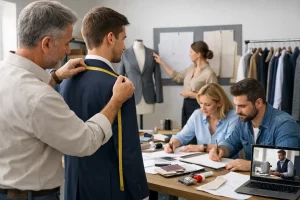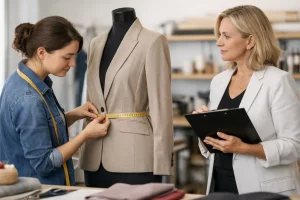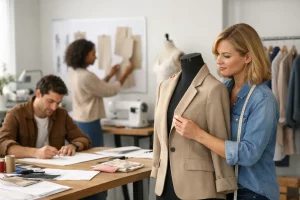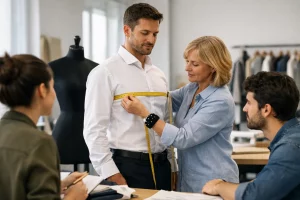
A career change into fashion rarely begins with a perfect CV. The question „Is it possible to switch careers into fashion?“ is therefore justified – and the short answer is: Yes, if interest in design is complemented by robust expertise, practical work, and a compelling portfolio. Creativity is a good starting point, but it neither replaces pattern cutting skills, clean finishing, nor an understanding of materials and fits.
The fashion and textile industry offers various entry points. Those coming from other professions don't necessarily have to start from scratch. Experience in design, sales, project management, craftsmanship, communication, or self-employment can be valuable. It is crucial to specifically combine this experience with professional qualifications in fashion design or tailoring.
Is it possible to switch careers into the fashion industry?
A career change into the fashion industry is possible, but it requires realistic preparation. Unlike fields where general interest is sufficient, fashion is a work environment with visible results. A design only becomes professional when it is constructively conceived, implemented with appropriate materials, and cleanly finished.
Consequently, employers, clients, or potential customers don't just assess a CV. They look at designs, technical drawings, patterns, sewing samples, fit, and the quality of a portfolio. For career changers, this presents an opportunity: practical skills can credibly complement work experience in unrelated fields and concretely demonstrate personal development.
The right path depends on the goal. Those who want to work as a designer need design confidence and a compelling project portfolio. Those who are more interested in product development, pattern cutting, or technical implementation should Cutting technique, To deepen knowledge of sewing techniques and materials science. The bespoke tailoring craft is particularly relevant for individual customer orders and high-quality custom-made items.
What the fashion industry expects from career changers
Fashion is creative, but not arbitrary. A collection or an individual item must be aesthetically convincing and, at the same time, wearable, producible, and functional. Professional expertise arises precisely at this interface.
The core foundations include developing ideas, drawing and colour concepts, selecting suitable materials, and knowledge of processing and fit. Added to this is the ability to translate a design into a pattern, cut a sample, sew it, and critically assess it. Those who understand these steps can make more informed decisions in design and communicate with production, clients, or other specialist areas on an equal footing.
For this reason, a career change is usually more successful through structured further training than through individual, unconnected learning opportunities. Short impulses can provide inspiration. However, for a professional reorientation, a learning path is needed that combines theory, practical exercises, correction, and project work.
The portfolio is not a photo album
For many positions and projects in the fashion industry, a portfolio more important than a general self-presentation. It should not only show finished, photogenically staged looks. A good portfolio makes the working process visible: from research and mood board through design and technical development to the implemented model.
Projects where one's own role becomes clearly apparent are particularly insightful. Was the pattern developed or adapted by you? Which finishing technique was chosen and why? How was the fit checked? What alterations resulted from a fitting? Such information demonstrates professional maturity and the ability to work precisely with lessons learned from mistakes.
In the beginning, less is often more. Three to five carefully documented projects with a traceable development are more convincing than numerous loose sketches or images without technical context. Portfolio development is therefore not an add-on at the end of a course, but should accompany the learning process.
What previous professional experience can help
A previous profession doesn't have to be a detour. People from creative professions often bring a flair for design, visual language, or target audiences. Those who have worked in retail or customer service may understand fit issues, customer needs, or the practical impact of clothing in everyday life.
Craftsmanship experience also provides a solid foundation. Precision, understanding of materials, spatial reasoning, and patience in working out details are directly helpful in fashion design and sewing techniques. Individuals with an organisational background can apply their skills to collections, production processes, or building their own brand.
This prior experience does not replace professional qualifications. However, it can help in developing your own profile. A career change does not necessarily mean abandoning your previous path. Often, a credible positioning arises precisely from the combination of two skill sets.
The practical way into the industry
At the outset, there is a clear definition of the objective. It makes a difference whether you wish to work as an employed professional, build your own fashion brand, develop custom-made pieces, or specialise in pattern cutting. The objective determines which content and how much depth of further training is sensible.
After this, the building of fundamentals follows. This includes design, construction, sewing techniques, materials science, and fit assessment. It is particularly important not just to follow instructions. Professional learning means understanding connections: why does a seam line change the silhouette? How does a fabric behave when draped? How much ease does a garment need to allow for movement?
In the next step, you will create your own projects. This is where you translate knowledge into concrete work and lay the foundation for your portfolio. Personal, professional guidance is valuable because feedback highlights mistakes, potentials, and sensible next steps. Independent digital learning can be flexible, but it achieves its professional impact primarily when practical tasks are constructively corrected and further developed.
Ultimately, the transition to professional practice requires sober planning. Applications, contracts or starting a business demand different documents and strategies. Not every further training leads to the same role, and not every role suits every profile. Good professional qualification therefore also helps to realistically assess one's own opportunities.
Further training, development and learning format consciously chosen
For a sustainable career change, the quality of further training should be measurable in terms of content and support. Relevant questions are: Is cutting technique taught practically? Are there exercises in sewing techniques and processing? Are own patterns developed? Do participants receive specific technical feedback? And is portfolio development systematically supported?
A flexible digital format can be particularly useful for working professionals, those returning to work, or people with family commitments. However, flexibility should not mean being left alone with complex technical questions. Expert guidance, precise correction, and room for repetition are needed, especially when it comes to cutting and fitting.
For jobseekers or those at risk of unemployment, funding can be provided through a training voucher fundamentally be a possible way. Whether further training is eligible for funding and whether the individual requirements are met will always be clarified in a personal discussion with the responsible authority. An AZAV-certified training provider can transparently provide the necessary information about the measure.
UniFash combines digital learning with personal professional support, practical projects, and portfolio development in fashion design further education. This approach is aimed at individuals who are not only seeking inspiration but also want to build practical skills for a professional future.
Frequently asked questions about changing careers into the fashion industry
Do I need a fashion degree to get started?
Not necessarily. For many career paths, demonstrable skills, practical experience, and a compelling portfolio are what count. A degree can be suitable, but it's not the only route. Practical further training can be a good alternative if it imparts sound content and allows for personal projects.
Can I learn fashion design with no sewing experience?
Yes, provided you are prepared to build the fundamentals carefully. Previous sewing experience is helpful, but not a prerequisite. Regular practice, patience, and a willingness to understand technical connections are crucial. Those who wish to design will benefit significantly in the long run from being able to follow the creation of a garment themselves.
How long does a career change take?
This depends on the starting level, the desired professional field, and the time commitment for the qualification. A viable portfolio isn't created overnight. However, by learning the core skills and carefully developing several projects, one can gradually build a solid foundation for applications, assignments, or further specialisation.
The first step doesn't have to be perfect. It just needs to be professionally justified: Choose an educational path that takes your creative motivation seriously, builds your practical skills, and allows you to develop visible results. In this way, the desire for fashion becomes a comprehensible professional path.