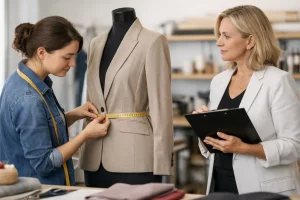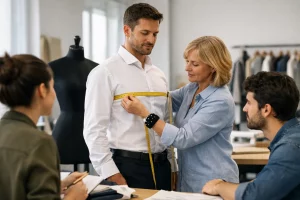

A jacket can be made from a high-quality fabric and still appear ill-fitting if the shoulders, chest, sleeves, or balance are not correct. This is precisely where made-to-measure begins: it combines design ideas with precise construction and skilled craftsmanship. Further training in made-to-measure for adults is aimed at individuals who want to understand and apply these connections professionally and translate them into their own models.
It is not a shortcut to workshop safety. A good fit is achieved through systematic work: analysing measurements, creating or adapting basic patterns, correctly assessing materials, planning production steps and evaluating fittings. For adults looking to reorient themselves or specialise, the field offers a challenging combination of design, pattern cutting and sewing techniques.
What made-to-measure tailoring means professionally
Made-to-measure tailoring sits between standardised ready-to-wear clothing and completely individually developed bespoke tailoring. Often, a carefully developed base pattern forms the foundation. This is then adapted to specific body measurements, proportions, fit preferences, and the chosen style. Unlike with mass-produced items, the focus is not solely on the ready-to-wear size, but on the wearer and the technical feasibility of their garment.
This demands more than just a good eye for style. Anyone working with bespoke tailoring must understand how pattern pieces interact, which ease allowances enable movement, and how fabrics behave under tension, steam, and stress. Construction and fit adjustments are also closely linked: a change to the shoulder can affect the sleeve hang, and a different interlining can alter the drape of a lapel.
Professionally, bespoke tailoring therefore encompasses three levels. The design level develops silhouette, details, and proportion. The technical level translates this idea into a wearable pattern. The craftsmanship level implements it precisely and checks the result during the fitting. Only their interaction creates clothing that looks convincing and is appropriately worn.
Who further training in custom tailoring for adults is suitable for
Professional development can be particularly beneficial when there is already a creative interest but a lack of technical foundation. This applies to career changers as well as people from sales, styling, textiles, costume, design or related craft professions. People returning to work after a break can also specifically enhance their existing experience with current pattern-making and processing skills.
It's not crucial whether someone has already sewn many garments. More important are concentration, patience, and the willingness to understand corrections as part of the learning process. Bespoke tailoring demands precision. Someone who unpicks a seam to improve the fit is not working backwards, but professionally.
Further training can also be valuable for aspiring founders of their own fashion brand. It helps to develop designs that are more technically realistic, to communicate fit decisions understandably, and to manage collaboration with production or pattern development more effectively. However, it does not automatically replace business planning, brand building, or comprehensive production structures. Which competencies should be prioritised depends on the individual career goal.
What subject-specific competencies count in teaching
A sound professional qualification builds content upon itself. At the beginning are Body measurements, size charts, Proportion theory and the logic of basic layouts. From this, an understanding develops as to why a pattern is not simply a drawing, but a spatial construction for a moving body.
Cutting technique: From basic cut to model
In the cutting technique, participants learn to transfer darts, create seam divisions, control widths, and constructively implement design lines. This includes, for example, bodices, skirts, trousers, sleeves, collars, or jacket details – depending on the focus of the programme. It is essential not only to execute changes according to a pattern but also to justify their effect on form, fit, and processing.
Fit analysis is also part of this. If a garment doesn't fit convincingly in one area, it requires a clear diagnosis: Is the cause due to the cut, the accuracy of the cutting, the material, or the manufacturing process? This distinction saves time and prevents corrections being made in the wrong place.
Seam technology and craftsmanship: quality you can see and feel
Sewing technique is not a downstream work step in custom tailoring. Seam types, interfacings, pressing techniques, edge finishes, fastenings and hem constructions influence durability, comfort and appearance. Anyone wishing to develop high-quality clothing should therefore not only know how a detail is sewn, but why this construction is suitable for the material and the desired shape.
The importance of this knowledge is particularly evident when working with demanding fabrics. A light wool fabric, a stable cotton fabric, and a flowing material will react differently to cutting, interfacing, and ironing. Materials science creates here the foundation for objective decisions instead of mere habit.
Fitting and alteration: The path to a perfect fit
The fitting is a technical inspection point, not a mere presentation. It shows how a garment behaves on the body, whether there is freedom of movement, and what adjustments are sensible. This hones the eye for balance: front and back length, shoulder line, side seam, hemline, and sleeve hang must be assessed as a whole.
Adult learners benefit from clearly documented corrections. Notes, technical sketches, photographs and cutting marks make decisions traceable later on. This working method not only strengthens precision but also the ability to present projects professionally.
Learning digitally, working manually
Further education in the fashion sector can meaningfully combine digital learning phases with personal, professional guidance. Theory on pattern systems, material properties, or manufacturing can be structured and studied digitally. Practical tasks, on the other hand, require feedback: Is the seam allowance correctly applied? Has the alteration been cleanly transferred to the pattern? Does the manufacturing meet the desired quality standard?
For adults, this combination is often helpful because it combines independent learning with mandatory guidance. Flexible learning components can better reconcile further education with family commitments or a career transition phase. At the same time, flexibility must not lead to isolated learning. Especially with fit and processing, qualified feedback significantly accelerates progress.
Practical projects are of particular importance here. A developed and cleanly implemented model demonstrates more than a theoretical certificate of attendance. It documents an understanding of interfaces, craftsmanship, material choices, and design attitude. Several comprehensibly structured pieces of work can thus form the basis for credible portfolio development.
Selecting the appropriate further training realistically
When making a choice, the name of a course alone should not be the deciding factor. Bespoke tailoring, custom tailoring, pattern cutting, and fashion design overlap but place different emphasis. Someone who primarily wants to develop designs needs a different balance of design and manufacturing than someone who later wants to correct fits or technically prepare small production runs.
A good programme makes content, learning formats and expected individual effort transparent. Ask specifically about the proportion of practical work, about support with seam and fit issues, and about the type of projects. It is also relevant whether portfolio development and career guidance are included. A mere introduction can be inspiring, but it is often not enough to confidently apply complex constructions.
For individuals interested in funding, being an AZAV-certified training provider can be relevant. A training voucher Under certain individual circumstances, professional further training can be subsidised. Whether subsidies are possible is clarified with the responsible authority in each case and should be checked in good time. Within this framework, UniFash combines digital learning opportunities with personal professional support, practical projects, and career guidance.
FAQs about Further Training in Made-to-Measure Clothing
Do I need prior knowledge of sewing techniques?
This depends on the structure and level of the further training. Basics help, but a structured programme can systematically develop technical knowledge. It's important to openly assess your own prerequisites and choose an offer that neither over- nor underwhelms you.
Is made-to-measure tailoring only relevant for classic women's or men's tailoring?
No. The principles of fit, pattern cutting and high-quality workmanship are relevant for different target groups and style directions. However, the specific focus of a programme determines which product groups and silhouettes are dealt with in more depth.
What career prospects can further training support?
It can lay the technical foundations for activities in pattern development, alteration and adaptation work, studio contexts, sample creation, design assistance or for one's own conceptual projects. Which perspective is realistic depends on prior experience, portfolio, specialisation, regional job market and practical development.
Those who learn made-to-measure tailoring learn, above all, to look more closely: at the body, the material, the cut, and the effect of each individual manufacturing step. This meticulousness is a viable foundation for personal development and for professional work in fashion that takes design and craftsmanship seriously.