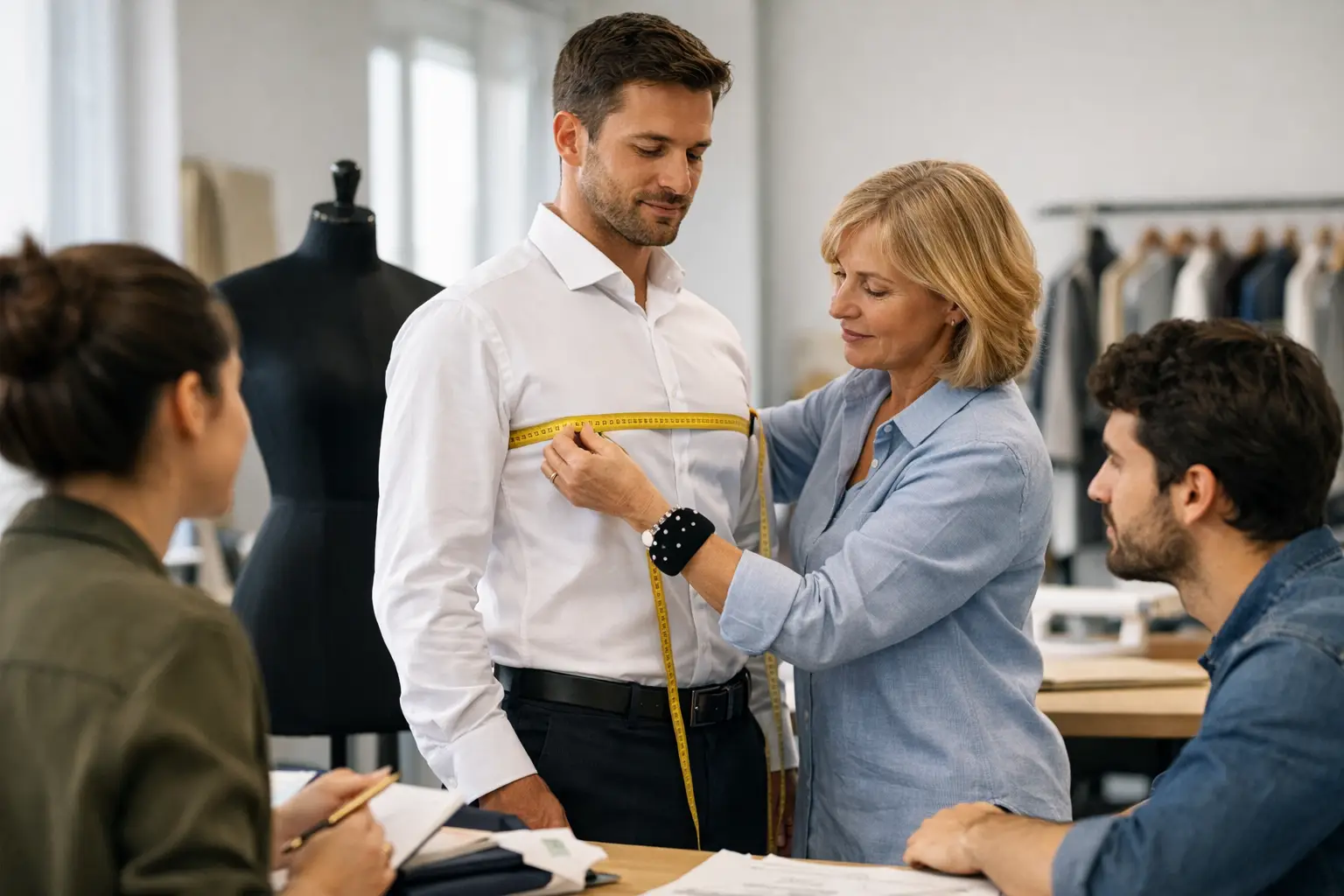

Further training in tailor-made clothing for adults

Further training in tailor-made clothing for adults

A jacket can be made from a high-quality fabric and still appear ill-fitting if the shoulders, chest, sleeves, or balance are not correct. This is precisely where made-to-measure begins: it combines design ideas with precise construction and skilled craftsmanship. Further training in made-to-measure for adults is aimed at individuals who want to understand and apply these connections professionally and translate them into their own models.

It is not a shortcut to workshop safety. A good fit is achieved through systematic work: analysing measurements, creating or adapting basic patterns, correctly assessing materials, planning production steps and evaluating fittings. For adults looking to reorient themselves or specialise, the field offers a challenging combination of design, pattern cutting and sewing techniques.

What made-to-measure tailoring means professionally

Made-to-measure tailoring sits between standardised ready-to-wear clothing and completely individually developed bespoke tailoring. Often, a carefully developed base pattern forms the foundation. This is then adapted to specific body measurements, proportions, fit preferences, and the chosen style. Unlike with mass-produced items, the focus is not solely on the ready-to-wear size, but on the wearer and the technical feasibility of their garment.

This demands more than just a good eye for style. Anyone working with bespoke tailoring must understand how pattern pieces interact, which ease allowances enable movement, and how fabrics behave under tension, steam, and stress. Construction and fit adjustments are also closely linked: a change to the shoulder can affect the sleeve hang, and a different interlining can alter the drape of a lapel.

Professionally, bespoke tailoring therefore encompasses three levels. The design level develops silhouette, details, and proportion. The technical level translates this idea into a wearable pattern. The craftsmanship level implements it precisely and checks the result during the fitting. Only their interaction creates clothing that looks convincing and is appropriately worn.

Who further training in custom tailoring for adults is suitable for

Professional development can be particularly beneficial when there is already a creative interest but a lack of technical foundation. This applies to career changers as well as people from sales, styling, textiles, costume, design or related craft professions. People returning to work after a break can also specifically enhance their existing experience with current pattern-making and processing skills.

It's not crucial whether someone has already sewn many garments. More important are concentration, patience, and the willingness to understand corrections as part of the learning process. Bespoke tailoring demands precision. Someone who unpicks a seam to improve the fit is not working backwards, but professionally.

Further training can also be valuable for aspiring founders of their own fashion brand. It helps to develop designs that are more technically realistic, to communicate fit decisions understandably, and to manage collaboration with production or pattern development more effectively. However, it does not automatically replace business planning, brand building, or comprehensive production structures. Which competencies should be prioritised depends on the individual career goal.

What subject-specific competencies count in teaching

A sound professional qualification builds content upon itself. At the beginning are Body measurements, size charts, Proportion theory and the logic of basic layouts. From this, an understanding develops as to why a pattern is not simply a drawing, but a spatial construction for a moving body.

Cutting technique: From basic cut to model

In the cutting technique, participants learn to transfer darts, create seam divisions, control widths, and constructively implement design lines. This includes, for example, bodices, skirts, trousers, sleeves, collars, or jacket details – depending on the focus of the programme. It is essential not only to execute changes according to a pattern but also to justify their effect on form, fit, and processing.

Fit analysis is also part of this. If a garment doesn't fit convincingly in one area, it requires a clear diagnosis: Is the cause due to the cut, the accuracy of the cutting, the material, or the manufacturing process? This distinction saves time and prevents corrections being made in the wrong place.

Seam technology and craftsmanship: quality you can see and feel

Sewing technique is not a downstream work step in custom tailoring. Seam types, interfacings, pressing techniques, edge finishes, fastenings and hem constructions influence durability, comfort and appearance. Anyone wishing to develop high-quality clothing should therefore not only know how a detail is sewn, but why this construction is suitable for the material and the desired shape.

The importance of this knowledge is particularly evident when working with demanding fabrics. A light wool fabric, a stable cotton fabric, and a flowing material will react differently to cutting, interfacing, and ironing. Materials science creates here the foundation for objective decisions instead of mere habit.

Fitting and alteration: The path to a perfect fit

The fitting is a technical inspection point, not a mere presentation. It shows how a garment behaves on the body, whether there is freedom of movement, and what adjustments are sensible. This hones the eye for balance: front and back length, shoulder line, side seam, hemline, and sleeve hang must be assessed as a whole.

Adult learners benefit from clearly documented corrections. Notes, technical sketches, photographs and cutting marks make decisions traceable later on. This working method not only strengthens precision but also the ability to present projects professionally.

Learning digitally, working manually

Further education in the fashion sector can meaningfully combine digital learning phases with personal, professional guidance. Theory on pattern systems, material properties, or manufacturing can be structured and studied digitally. Practical tasks, on the other hand, require feedback: Is the seam allowance correctly applied? Has the alteration been cleanly transferred to the pattern? Does the manufacturing meet the desired quality standard?

For adults, this combination is often helpful because it combines independent learning with mandatory guidance. Flexible learning components can better reconcile further education with family commitments or a career transition phase. At the same time, flexibility must not lead to isolated learning. Especially with fit and processing, qualified feedback significantly accelerates progress.

Practical projects are of particular importance here. A developed and cleanly implemented model demonstrates more than a theoretical certificate of attendance. It documents an understanding of interfaces, craftsmanship, material choices, and design attitude. Several comprehensibly structured pieces of work can thus form the basis for credible portfolio development.

Selecting the appropriate further training realistically

When making a choice, the name of a course alone should not be the deciding factor. Bespoke tailoring, custom tailoring, pattern cutting, and fashion design overlap but place different emphasis. Someone who primarily wants to develop designs needs a different balance of design and manufacturing than someone who later wants to correct fits or technically prepare small production runs.

A good programme makes content, learning formats and expected individual effort transparent. Ask specifically about the proportion of practical work, about support with seam and fit issues, and about the type of projects. It is also relevant whether portfolio development and career guidance are included. A mere introduction can be inspiring, but it is often not enough to confidently apply complex constructions.

For individuals interested in funding, being an AZAV-certified training provider can be relevant. A training voucher Under certain individual circumstances, professional further training can be subsidised. Whether subsidies are possible is clarified with the responsible authority in each case and should be checked in good time. Within this framework, UniFash combines digital learning opportunities with personal professional support, practical projects, and career guidance.

FAQs about Further Training in Made-to-Measure Clothing

Do I need prior knowledge of sewing techniques?

This depends on the structure and level of the further training. Basics help, but a structured programme can systematically develop technical knowledge. It's important to openly assess your own prerequisites and choose an offer that neither over- nor underwhelms you.

Is made-to-measure tailoring only relevant for classic women's or men's tailoring?

No. The principles of fit, pattern cutting and high-quality workmanship are relevant for different target groups and style directions. However, the specific focus of a programme determines which product groups and silhouettes are dealt with in more depth.

What career prospects can further training support?

It can lay the technical foundations for activities in pattern development, alteration and adaptation work, studio contexts, sample creation, design assistance or for one's own conceptual projects. Which perspective is realistic depends on prior experience, portfolio, specialisation, regional job market and practical development.

Those who learn made-to-measure tailoring learn, above all, to look more closely: at the body, the material, the cut, and the effect of each individual manufacturing step. This meticulousness is a viable foundation for personal development and for professional work in fashion that takes design and craftsmanship seriously.


Partial qualification tailor: external interim examination

Partial qualification tailor: external interim examination

Anyone who wants to work professionally in fashion, pattern cutting and manufacturing needs more than creative flair. Crucial are manual.

The Partial qualification in bespoke tailoring The UniFash | German Elite Fashion Academy creates a new educational path for this. The six-month, hybrid further education programme combines digitally conveyed specialist knowledge with extensive practical tasks and personal professional support. The special feature: The curriculum was developed to the Chamber of Crafts for Lower Franconia submitted and examined with regard to the contents of the first eighteen months of vocational training in the bespoke tailoring trade. Participants in UniFash will be admitted to the external interim examination on this basis. Participation in the examination is voluntary. Those who decide to take the examination and successfully pass it will receive an official interim examination certificate from the Chamber of Crafts.

The most important things at a glance

  • Duration of further training: six months
  • Learning format: blended further education
  • Focus: Fashion Design and Bespoke Tailoring
  • Funding: Education voucher possible
  • Training provider: AZAV-certified
  • Curriculum: professionally assessed by the Chamber of Crafts for Lower Franconia
  • Examination procedure: voluntary external interim examination
  • Examining body: competent Chamber of Crafts or Guild
  • Proof of passing: official intermediate examination certificate
  • First exam participation: September 2026

What does partial qualification mean in the bespoke tailoring trade?

A partial qualification imparts professionally relevant skills from a recognised occupational profile. It is particularly interesting for.

Reviewed by the Chamber of Skilled Trades for Lower Franconia

A crucial difference compared to many general sewing or fashion courses lies in the professional classification of the curriculum. UniFash has its curriculum classified as Chamber of Crafts for Lower Franconia submitted. It was examined whether the content conveyed meets the professional requirements of the first eighteen months of training in the recognised vocational occupation of bespoke tailor (male or female). On this basis, the Chamber of Crafts accepts UniFash participants for the external intermediate examination. For those who are interested, this curriculum review creates additional transparency. The competencies conveyed are not only based on freely chosen course content but on the specific professional requirements of the bespoke tailoring trade. UniFash thus combines the flexibility of modern further training with a clear orientation towards the quality standards of German craftsmanship.

Voluntary external intermediate examination in bespoke tailoring

Participation in the external interim examination is not a compulsory part of the further training. Each participant decides for themselves whether to make use of this additional examination route. The examination is not conducted by UniFash. It takes place before the responsible Chamber of Crafts or Guild and is carried out by an independent examination commission. Those who successfully pass the interim examination will receive the official interim examination certificate from the Chamber of Crafts. This proof documents that the examined professional and practical achievements have been successfully demonstrated. It can be of particular additional value for applications, in discussions with employers, or for further career planning. However, the interim examination is not equivalent to the journeyman's examination. The journeyman's certificate requires an additional and legally regulated examination process.

The first UniFash candidates will take their exams in September 2026

In September 2026, the first participants of UniFash will sit their external interim examination before the responsible guild. For UniFash, this is an important milestone. It shows that hybrid further training in the tailoring trade does not have to end with theoretical knowledge or internal participation certificates. Participants can voluntarily demonstrate their acquired skills before an external trade examination board. This approach is particularly exceptional for a hybrid qualification measure. The tailoring trade is traditionally strongly associated with exclusively company-based or school-based in-person tuition. The UniFash concept complements these established forms of education with flexible access for adults. The first examinations in September 2026 will therefore also serve as a practical test for a new approach in vocational further training.

Why hybrid education can work in the tailoring trade

Tailoring cannot be learned solely through reading or watching videos. Craftsmanship is developed through practical repetition, careful observation, corrections, and the continuous improvement of one's own work. A high-quality hybrid concept must therefore consistently combine digital knowledge transfer with practical application. At UniFash, theoretical basics, pattern making, construction techniques, and workflows are taught digitally. Participants then practically apply this content through specific exercises and clothing projects. The completed work, pattern making, and individual work steps are professionally supervised. Feedback helps to identify errors, improve construction techniques, and further develop one's own working methods. The hybrid model offers several advantages as a result:

  • Learning regardless of location
  • Clear and structured learning content
  • repeatable digital demonstrations
  • extensive practical tasks
  • Personal professional feedback
  • Independent planning of practical work phases
  • Setting up a professional work routine

Flexibility does not mean reducing the academic standard. Participants must apply their knowledge practically and demonstrate it through their own work results.

What skills are taught?

The advanced training covers key areas of fashion design and tailoring. It is not just about individual sewing techniques, but about the interplay of design, construction, material, craftsmanship and fit.

Professional measuring

Accurate body measurements form the basis for a perfectly fitting pattern construction. Participants will learn to professionally record, document, and use relevant measurements for further pattern construction. Even small measurement errors can later lead to significant fit problems. Therefore, accuracy, a standardised measurement method, and an understanding of body proportions are among the fundamental competencies.

Pattern cutting

In pattern cutting, two-dimensional pattern pieces are developed for three-dimensional body shapes. Participants will learn to construct basic patterns and adapt them to different styles. This includes, among other things, skirt and.

Sewing techniques and finishing

Professional sewing techniques go far beyond simply stitching individual fabric pieces together. Different materials, garments, and constructions each require appropriate finishing solutions. This course covers, among other things, neat seam finishes, the correct handling of machines and tools, and the planned sequence of individual work steps.

Materials science

Fabrics differ in terms of weight, drape, elasticity, surface and processing behaviour. These properties influence design, pattern cutting and manufacturing. Participants will learn to assess materials and select them appropriately for a planned garment.

Fit analysis and corrections

A pattern can be technically correct and.

Model Development

Based on basic patterns, original models are developed. Design ideas must be implemented in such a way that a technically functioning and wearable item of clothing is created. Model development combines creativity with constructive thinking and practical craftsmanship.

Manufacture of complete garments

Craftsmanship is particularly evident in the complete manufacturing process. Therefore, several practical assignments and garments are created during the further training. These include, among other things, different skirt styles, a business pair of trousers, and further projects that bring together pattern construction, cutting, processing, and quality control.

Portfolio development

A professional portfolio does not just document finished results. It also shows sketches, technical drawings, pattern developments, material choices, and individual work steps. This allows participants to credibly present their creative and craft skills.

Who is the partial qualification suitable for?

The professional development course is aimed at adults with diverse professional and personal backgrounds. It may be particularly suitable for:

  • Career changers
  • Jobseekers
  • People undergoing a career change
  • Career returners
  • Individuals with education vouchers
  • Graduates of domestic science schools
  • People with first-hand sewing experience
  • Creative talents with professional goals
  • Those interested in the tailoring trade
  • People who wish to design and create fashion professionally

Crucial are a willingness to learn, accuracy, and a readiness to regularly practise practical skills. Fashion tailoring requires patience. Not every step succeeds on the first attempt, and professional corrections are naturally part of the learning process.

Further training with an education voucher

This training programme is certified as an AZAV measure. Provided the personal eligibility criteria are met, funding may be available via a training voucher from the Employment Agency or the Jobcentre. A training voucher may, amongst other things, cover the course fees. Participants admitted via the funded programme will also be provided with the learning and work materials intended for the programme. The relevant Employment Agency or Jobcentre will decide whether to grant an education voucher based on the individual’s professional situation. Those interested should be able to explain during the advisory meeting what their career goals are and how the further training can improve their employment prospects. The programme number for the further training course is 759/170/25.

What career prospects arise?

Further training alone does not guarantee specific employment. However, it can impart skills that are needed in various areas of the fashion, clothing, and textile industries. Possible fields of activity include, for example:

  • Bespoke tailoring
  • Tailors
  • Fashion workshops
  • Bridal and formal wear boutiques
  • Costume departments
  • Theatre and Opera
  • Film and media productions
  • Sample production
  • Clothing company
  • textile workshops
  • own fashion projects
  • Preparatory steps to self-employment

Which professional perspective is realistic depends on individual skills, practical work results, previous experience, and the regional labour market. A portfolio and a successfully completed interim examination certificate can help to demonstrate acquired competencies to potential employers in a comprehensible way.

Partial qualification, further training and apprenticeships compared

The terms 'Teilqualifizierung'.

Quality over quick promises

The craft of bespoke tailoring cannot be fully mastered in just a few weeks. Offers that promise a quick professional qualification without intensive practical training should be viewed with a critical eye. A high-quality training programme must clearly explain:

  • what content is taught
  • how practical lessons are delivered
  • What services need to be provided
  • who professionally supports the participants
  • which certificates are issued
  • which external examinations are possible
  • what formal value the respective supporting documents have

UniFash therefore clearly distinguishes between its own further education completion certificate and the official interim examination certificate from the Chamber of Crafts.

A new approach to a traditional craft

Tailoring stands for individuality, quality, and precise workmanship. At the same time, the trade requires new approaches so that adults, career changers, and those returning to work can also qualify. With a professionally accredited curriculum, a six-month hybrid further training course, and the voluntary option for an external interim examination, UniFash combines traditional tailoring skills with modern vocational training. The first examination participations in September 2026 mark an important step. They show that digital knowledge transfer, practical self-study, professional guidance, and an independent trade examination can be meaningfully combined. This creates a transparent educational pathway for interested individuals: from the basics of pattern cutting and sewing techniques to their own clothing projects and the opportunity to demonstrate the acquired skills before the Chamber of Crafts or the relevant guild.

Frequently asked questions about partial qualifications in the tailoring trade

Is the further education a complete training?

No. The six-month advanced training course is not a full vocational training and does not, on its own, lead to a journeyman's certificate. The curriculum is based on the content of the first eighteen months of vocational training in the bespoke tailoring trade.

Has the Chamber of Crafts approved the curriculum?

Yes. The curriculum was submitted to the Chamber of Crafts for Lower Franconia and its content for the first eighteen months of training was professionally reviewed.

Are UniFash participants admitted to the interim examination?

Yes. The Chamber of Crafts accepts participants from UniFash for the external intermediate examination in tailoring.

Is participation in the interim examination compulsory?

No. Participation is voluntary. Participants can also complete the further training without the subsequent intermediate examination.

Who conducts the interim examination?

The examination is carried out by the responsible Chamber of Crafts or Tailors' Guild. UniFash itself does not conduct the examination.

What do I receive after passing the interim examination?

Those who pass the examination successfully will receive an official intermediate examination certificate from the Chamber of Skilled Crafts.

Is the intermediate examination certificate a journeyman's certificate?

No. The interim examination documents the achieved level of training and competence. The journeyman's certificate requires successful participation in the complete journeyman's examination and fulfilment of the applicable prerequisites for it.

When do the first exams take place?

The first UniFash participants will take their intermediate examination before the relevant guild in September 2026.

Can further training be funded with an education voucher?

Yes. The measure is AZAV-certified. If the personal requirements are met, funding can be provided by the Employment Agency or the Job Centre.

How long does the further training take?

The further training lasts six months full-time and comprises 720 teaching units.

Is the further training conducted exclusively theoretically?

No. In addition to digitally delivered specialist content, the further training includes extensive practical exercises, pattern constructions, and the creation of your own garments.

Do I need prior sewing experience?

Prior knowledge can make starting easier, but it is not solely decisive. Craftsmanship interest, accuracy, a willingness to learn, and the opportunity to work practically on a regular basis are important.

What technical equipment is required?

A standard computer with an up-to-date browser, a stable internet connection, and a suitable sewing machine are required.

Will I also receive a certificate from UniFash?

Upon successful completion, graduates will receive the UniFash certificate of completion. The voluntary interim examination certificate will be issued independently by the responsible Chamber of Crafts.

Is it possible to switch careers into the fashion industry?

Is it possible to switch careers into the fashion industry?

A career change into fashion rarely begins with a perfect CV. The question „Is it possible to switch careers into fashion?“ is therefore justified – and the short answer is: Yes, if interest in design is complemented by robust expertise, practical work, and a compelling portfolio. Creativity is a good starting point, but it neither replaces pattern cutting skills, clean finishing, nor an understanding of materials and fits.

The fashion and textile industry offers various entry points. Those coming from other professions don't necessarily have to start from scratch. Experience in design, sales, project management, craftsmanship, communication, or self-employment can be valuable. It is crucial to specifically combine this experience with professional qualifications in fashion design or tailoring.

Is it possible to switch careers into the fashion industry?

A career change into the fashion industry is possible, but it requires realistic preparation. Unlike fields where general interest is sufficient, fashion is a work environment with visible results. A design only becomes professional when it is constructively conceived, implemented with appropriate materials, and cleanly finished.

Consequently, employers, clients, or potential customers don't just assess a CV. They look at designs, technical drawings, patterns, sewing samples, fit, and the quality of a portfolio. For career changers, this presents an opportunity: practical skills can credibly complement work experience in unrelated fields and concretely demonstrate personal development.

The right path depends on the goal. Those who want to work as a designer need design confidence and a compelling project portfolio. Those who are more interested in product development, pattern cutting, or technical implementation should Cutting technique, To deepen knowledge of sewing techniques and materials science. The bespoke tailoring craft is particularly relevant for individual customer orders and high-quality custom-made items.

What the fashion industry expects from career changers

Fashion is creative, but not arbitrary. A collection or an individual item must be aesthetically convincing and, at the same time, wearable, producible, and functional. Professional expertise arises precisely at this interface.

The core foundations include developing ideas, drawing and colour concepts, selecting suitable materials, and knowledge of processing and fit. Added to this is the ability to translate a design into a pattern, cut a sample, sew it, and critically assess it. Those who understand these steps can make more informed decisions in design and communicate with production, clients, or other specialist areas on an equal footing.

For this reason, a career change is usually more successful through structured further training than through individual, unconnected learning opportunities. Short impulses can provide inspiration. However, for a professional reorientation, a learning path is needed that combines theory, practical exercises, correction, and project work.

The portfolio is not a photo album

For many positions and projects in the fashion industry, a portfolio more important than a general self-presentation. It should not only show finished, photogenically staged looks. A good portfolio makes the working process visible: from research and mood board through design and technical development to the implemented model.

Projects where one's own role becomes clearly apparent are particularly insightful. Was the pattern developed or adapted by you? Which finishing technique was chosen and why? How was the fit checked? What alterations resulted from a fitting? Such information demonstrates professional maturity and the ability to work precisely with lessons learned from mistakes.

In the beginning, less is often more. Three to five carefully documented projects with a traceable development are more convincing than numerous loose sketches or images without technical context. Portfolio development is therefore not an add-on at the end of a course, but should accompany the learning process.

What previous professional experience can help

A previous profession doesn't have to be a detour. People from creative professions often bring a flair for design, visual language, or target audiences. Those who have worked in retail or customer service may understand fit issues, customer needs, or the practical impact of clothing in everyday life.

Craftsmanship experience also provides a solid foundation. Precision, understanding of materials, spatial reasoning, and patience in working out details are directly helpful in fashion design and sewing techniques. Individuals with an organisational background can apply their skills to collections, production processes, or building their own brand.

This prior experience does not replace professional qualifications. However, it can help in developing your own profile. A career change does not necessarily mean abandoning your previous path. Often, a credible positioning arises precisely from the combination of two skill sets.

The practical way into the industry

At the outset, there is a clear definition of the objective. It makes a difference whether you wish to work as an employed professional, build your own fashion brand, develop custom-made pieces, or specialise in pattern cutting. The objective determines which content and how much depth of further training is sensible.

After this, the building of fundamentals follows. This includes design, construction, sewing techniques, materials science, and fit assessment. It is particularly important not just to follow instructions. Professional learning means understanding connections: why does a seam line change the silhouette? How does a fabric behave when draped? How much ease does a garment need to allow for movement?

In the next step, you will create your own projects. This is where you translate knowledge into concrete work and lay the foundation for your portfolio. Personal, professional guidance is valuable because feedback highlights mistakes, potentials, and sensible next steps. Independent digital learning can be flexible, but it achieves its professional impact primarily when practical tasks are constructively corrected and further developed.

Ultimately, the transition to professional practice requires sober planning. Applications, contracts or starting a business demand different documents and strategies. Not every further training leads to the same role, and not every role suits every profile. Good professional qualification therefore also helps to realistically assess one's own opportunities.

Further training, development and learning format consciously chosen

For a sustainable career change, the quality of further training should be measurable in terms of content and support. Relevant questions are: Is cutting technique taught practically? Are there exercises in sewing techniques and processing? Are own patterns developed? Do participants receive specific technical feedback? And is portfolio development systematically supported?

A flexible digital format can be particularly useful for working professionals, those returning to work, or people with family commitments. However, flexibility should not mean being left alone with complex technical questions. Expert guidance, precise correction, and room for repetition are needed, especially when it comes to cutting and fitting.

For jobseekers or those at risk of unemployment, funding can be provided through a training voucher fundamentally be a possible way. Whether further training is eligible for funding and whether the individual requirements are met will always be clarified in a personal discussion with the responsible authority. An AZAV-certified training provider can transparently provide the necessary information about the measure.

UniFash combines digital learning with personal professional support, practical projects, and portfolio development in fashion design further education. This approach is aimed at individuals who are not only seeking inspiration but also want to build practical skills for a professional future.

Frequently asked questions about changing careers into the fashion industry

Do I need a fashion degree to get started?

Not necessarily. For many career paths, demonstrable skills, practical experience, and a compelling portfolio are what count. A degree can be suitable, but it's not the only route. Practical further training can be a good alternative if it imparts sound content and allows for personal projects.

Can I learn fashion design with no sewing experience?

Yes, provided you are prepared to build the fundamentals carefully. Previous sewing experience is helpful, but not a prerequisite. Regular practice, patience, and a willingness to understand technical connections are crucial. Those who wish to design will benefit significantly in the long run from being able to follow the creation of a garment themselves.

How long does a career change take?

This depends on the starting level, the desired professional field, and the time commitment for the qualification. A viable portfolio isn't created overnight. However, by learning the core skills and carefully developing several projects, one can gradually build a solid foundation for applications, assignments, or further specialisation.

The first step doesn't have to be perfect. It just needs to be professionally justified: Choose an educational path that takes your creative motivation seriously, builds your practical skills, and allows you to develop visible results. In this way, the desire for fashion becomes a comprehensible professional path.

Measuring for tailoring: learning the right way

Measuring for tailoring: learning the right way

One sleeve pulls forward, even though the armscye is neatly worked. Trousers create folds under the buttocks, even though the side seam falls straight. Such fit problems often don't start with sewing, but with inaccurate body measurements. If Learning to take measurements for tailoring wants to learn more than just reading a measuring tape: It's about technically recognising posture, proportions and movement spaces and translating them into a viable pattern solution.

Why taking measurements is crucial in bespoke tailoring

Tailoring doesn't work with an abstract standard body. Every person brings individual characteristics: shoulders of different heights, a pronounced or flat back line, a changed waist position, postural influences, or special length proportions. Taking measurements creates the basis for comprehensibly recording these characteristics.

It is not enough to simply record chest, waist, and hip measurements. A professional set of measurements combines circumference, length, and control measurements. Only their interplay shows whether a basic pattern needs to be adjusted and where width, length, or balance should be changed. The craft skill lies in not viewing measurements in isolation, but in reading them as a picture of a real body.

This is particularly relevant for custom-made clothing, sample pieces, fittings, and the development of your own fashion brand. Those who construct or adapt patterns can only reliably assess the fit if measurements are collected, documented, and later compared with the garment in a precise manner.

Correct preparation before measuring

Professional measurements begin with calm, clear preparation. The person stands upright but relaxed. An artificially corrected posture distorts the measurements, as does a puffed-out chest or a tucked-in stomach. Measurements are taken over close-fitting clothing or underwear, depending on the final product and company standards.

A high-quality measuring tape should be flexible, dimensionally stable and easy to read. In addition, a waist band, a measurement chart, a pen and, if necessary, mirrors and a camera for posture observation are helpful. The waist band marks the natural waistline and prevents length measurements from deviating from changing reference points during measurement.

Before the first number is the observation. How are the shoulder line and back? Is the hip straight or unevenly developed to the side? Does one shoulder stand further forward? These impressions are not a diagnosis and do not replace measurements. However, they help to record peculiarities and to check them specifically during pattern adjustment.

Taking measurements for bespoke tailoring: The most important measurement groups

A complete set of measurements always takes into account the type of garment, the cutting system, and the desired silhouette. Different specifications are needed for a shirt, a jacket, or trousers. Nevertheless, the central measurements can be organised into three groups.

Measure circumferences correctly

Circumference measurements such as bust, waist, hip, neck, upper arm, or thigh width are taken horizontally to the body's axis. The tape measure should lie flat but not dig in. Loosely measured circumferences will result in unnecessary extra width later; measurements taken too tightly will lead to a cut that restricts movement and wearing comfort.

The measuring height is important. The chest width is measured at the widest point, and the hip width at the widest part of the hips or buttocks. Especially with different body shapes, it can be advisable to take additional check measurements. These help to adjust the distribution of width in the pattern in a differentiated way, instead of just increasing or decreasing the overall circumference.

Take length measurements with clear reference points

Length measurements describe the proportions of the body. These include, for example, back length, front length, side length, sleeve length, inside leg length, or the length from the base of the neck to the bust. It is crucial to always measure from clearly defined points.

For example, the back waist can be significantly different from the front waist. If both areas are treated with a single standard measurement, a top can ride up at the back or appear too long at the front. Good measurement makes such differences visible. It thus provides the basis for a balanced front and back section balance.

Include control measurements and posture

Check control measurements to see if a cut fits the person both mathematically and visually. This can include shoulder width, chest depth, back width, arm length to the wrist, or seat height for trousers. They are particularly valuable when measurements vary noticeably or when a fitting later indicates balance errors.

Postural stance isn't about pigeonholing people. It's about the objective question of how the body carries a garment. A forward-leaning posture, for example, changes the required back length and shoulder position. Precise observation supports pattern cutting technique, but it never replaces fitting on the model.

From numbers to seam adjustment

A pattern sheet is not yet a garment. The next step is to connect the measurements with a basic pattern or individual drafting. This is where the difference between mere measuring and professional bespoke tailoring.

Let's consider a top with a large difference between the bust and waist measurements. The extra width must be incorporated into the design, for example, using darts, dividing seams, or a different cut. If there's a significant shoulder difference, the shoulder line may need to be adjusted. The best solution depends on the design, material, need for movement, and the desired silhouette.

The choice of fabric also changes the assessment. A Firm wool fabric reacts differently to an elastic jersey or a flowing viscose fabric. While measurements remain the basis, ease and construction must suit the material. Therefore, tailoring always requires the interplay of pattern cutting, sewing techniques, material science, and fittings.

Common measuring mistakes

Many errors arise not from a lack of diligence, but from a lack of systematic approach. A measuring tape is held at an angle, a person unknowingly changes their posture, or a value is recorded without a reference point. Such deviations seem small, but they add up on average.

Another common mistake is mixing up body measurements and finished garment measurements. Body measurements describe the body, while finished garment measurements describe the final piece of clothing, including necessary ease. If these two are not kept separate, it's impossible to plan fit or ease of movement in a comprehensible way.

It is equally problematic to forgo a fitting. Even meticulously taken measurements cannot anticipate every effect of a fabric, a construction, or an individual posture. A fitting is therefore not a sign that work was done incorrectly. It is a professional inspection step where measurement, pattern, and workmanship come together.

This is how security develops in practice

Taking measurements improves with repetition, but not with repetition alone. The professional assessment is crucial: was the measurement taken in the right place? Does the cut change match the observed feature? How is the decision reflected in the fitting? Those who document these questions will develop a reliable understanding of fit more quickly.

It is sensible to work with clear basic models, such as a skirt, trousers, and a top. Different measurement groups and corrections can be practiced understandably on these. A structured measurement sheet, photos of the fitting with the consent of the person concerned, and precise notes create a valuable working basis for portfolio development.

In a practice-oriented fashion design further education course, taking measurements is therefore not relegated to the sidelines of the curriculum. It is directly linked to pattern cutting, manufacturing, and design decisions. Personal professional guidance is particularly helpful because it not only checks measurements but also explains their impact on the pattern and the garment.

Who it's particularly worthwhile for

In-depth knowledge of taking measurements is just as relevant for aspiring bespoke tailors as it is for people in the career reorientation, for cutting technicians, designers and founders of small fashion labels. They create a professional foundation to more competently assess individual customer orders, pattern development and fit corrections.

The appropriate learning path depends on your goal. Those who wish to develop professional custom-made garments need a particularly deep understanding of body measurements, pattern construction, and fitting. Those who primarily work in fashion design should still have a confident command of taking measurements, in order to be able to constructively implement designs and to conduct informed communication with pattern cutting and production.

UniFash provides a practical approach to craftsmanship within premium fashion education, rather than teaching it in isolation of its application. Taking measurements becomes tangible when a pattern is created from a spec sheet, and from that pattern, a garment is made, whose fit can be demonstrably assessed.

Frequently asked questions about taking measurements

How many fittings should be done for a bespoke garment?

At least one full measurement set is necessary. Depending on the garment, lead time, and any issues during the fitting, a check measurement may be beneficial. It is often helpful for close-fitting or specially constructed models.

Can you learn measuring digitally?

Theoretical foundations, measurement sheets and seam connections can be well developed digitally. For professional safety, practical practice on people, feedback on handling and measurement progress, as well as the evaluation of real fittings are also necessary.

Are standard sizes sufficient as a basis?

Standard sizes offer an important starting point for industrial tailoring and basic patterns. However, they are insufficient for bespoke clothing as they only allow for limited representation of individual proportions, posture, and desired ease.

Precise measurement is not a secondary task before the actual design. It is the moment when creative idea and craftsmanship reality are connected – and herein lies the quality of a perfectly fitting piece of work.

Material science fabrics for fashion correctly choose

Material science fabrics for fashion correctly choose

A coat can seem precise in its design yet disappoint in its execution: the fabric sticks out, a seam puckers, or the collar loses its shape. Materials science fabrics for fashion Therefore, it is not an addition to design, but a foundation for professional design decisions. Those who understand the fibre, weave, weight and behaviour of a material develop designs that can not only be drawn, but also convincingly constructed and processed.

Why fabric knowledge is crucial in fashion design

Fabrics determine how a silhouette is read. A flowing viscose weave supports a softly draping blouse, while a dense wool fabric lends contour and form to a blazer. The same cut can look, fit and move completely differently in both materials.

For professional practice, it is not enough to classify a fabric as „soft“, „firm“ or „high-quality“. What is crucial are the properties relevant to a specific model: stretch, recovery, drape, abrasion resistance, transparency, thermal behaviour and care requirements. These properties influence The development of the seam, the choice of insoles, the stitching technique, and the subsequent comfort.

Good material choices therefore don't only start at the point of purchase. They begin with a clear question: What function should the garment fulfil and what effect should it have on the body?

Fibre Science: The Origin of Material Properties

Every fabric starts with a fibre. Its chemical and physical structure shapes many properties of the finished textile. For fashion design and tailoring, it is useful to be able to distinguish between natural fibres, regenerated fibres, and synthetic fibres.

Natural fibres: character, comfort and care

Cotton is kind to the skin, absorbent, and versatile. Depending on the weave, it can be light and airy or robust and firm. However, pure cotton creases relatively quickly and dries more slowly than many synthetic fibres. It is often a good basis for shirts, blouses, trousers, or workwear, provided the cut and intended use are suitable.

Wool has natural elasticity and good thermal regulation. It can act as a moisture regulator and doesn't absorb odours as quickly as some other fibres. However, wool requires care when processing: heat, steam, ironing techniques and interlinings must be suited to the respective woollen fabric. It opens up many construction possibilities, especially in tailored garments.

Linen feels cool, dry and has character, but it creases significantly. This is not a defect in quality, but part of its material aesthetic. Anyone using linen should consider this characteristic in their design, rather than expecting a smooth, dimensionally stable effect.

Silk can drape very finely, smoothly, and elegantly. However, it is more sensitive to friction, moisture, and certain processing steps. With transparent or slippery silks, careful pattern draping, appropriate needles, and controlled seam processing are particularly important.

Regenerated and synthetic fibres: Precise evaluation based on application

Viscose is made from cellulose and can feel soft, cool, and fluid. It is often suitable for dresses, blouses, and loose-fitting trousers, but can lose stability when wet. Pre-washing and appropriate garment construction are therefore advisable if the item is to be washable later.

Lyocell also counts among the cellulosic regenerated fibres. It often combines a soft feel with good strength and can appear very different depending on the fabric. As with any material: the fibre name alone doesn't tell you everything about the fabric.

Polyester, polyamide, and elastane are often prejudged. A more technically sensible question is about their function. Polyester can be dimensionally stable, hard-wearing and easy to care for. Polyamide is used, for example, for high abrasion resistance. Elastane, even in small proportions, provides stretch and freedom of movement. At the same time, blends can alter ironing behaviour, breathability and subsequent repairability.

From Fibre to Fabric: Bonding, Knitting and Weight

Two fabrics made from the same fibre can have opposite properties. Cotton poplin drapes differently to cotton sateen, and wool cloth differently to wool jersey. The construction of the textile is therefore just as important as the fibre itself.

Woven fabrics are made from warp and weft threads. Plain weave is usually stable and has a clear surface, twill weave often shows a diagonal structure and can drape more smoothly. Satin weaves create a smoother, often shiny side, but depending on the material, are more susceptible to snags or pressure marks.

Knitted fabrics, such as jersey, are made from loops. They are usually more stretchy and comfortable to wear than woven fabrics. This characteristic fundamentally changes the cutting technique: a close-fitting jersey shirt requires different ease allowances, seam types, and hems than a similarly cut top made from woven fabric. Therefore, professionals assessing fabrics always consider the fibre and fabric construction together.

The weight of the fabric also matters. A heavy fabric doesn't automatically guarantee quality, but it can give a garment more structure. A light fabric can be finished to an especially high standard, but may still require sheerness, lining, or French seams. The right choice depends on the model, the season, the target audience, and the desired drape.

Materials science for fabrics in fashion - practical application

Before cutting, fabric should not just be visually inspected. Feel it, lay it over a hand or dress form and observe how it drapes. Gently pull it in warp, weft, and diagonal directions. This will reveal if and where it yields.

Subsequently, create a small fabric sample. A test stitch shows if the material waves, frays, or shifts under the sewing foot. An ironing test on a remnant helps to assess how sensitive the surface is to temperature, steam, and pressure. For critical fabrics, a test wash is also advisable so that shrinking, distortion, or colour changes are not only apparent on the finished garment.

This test is not an unnecessary intermediate step. It saves time in cutting techniques and prevents decisions that would later be difficult to rectify. Especially in portfolio work shows a material-appropriate implementation, where design and craftsmanship have been brought together.

The cut and finishing must suit the material.

A seam is not a neutral element. Its effect is created through its interaction with the fabric. A narrow sheath dress made of stable woven fabric requires ease of movement and, if necessary, a slit, whereas elastic jersey can manage with less extra width. A wide skirt made of lightweight fabric might not need much interfacing but can benefit from a carefully stabilised waist.

Interfacing plays a central role in shaping garments. It should support the fabric, not work against it. An interlining that is too heavy can stiffen a fine outer fabric; an interlining that is too light may not give a lapel enough support. Lining is also functional: it often improves ease of wear, protects delicate outer fabrics, and influences the drape.

Seam allowances, stitch length, needle size, and finishing are also material decisions. Loosely woven fabrics often require secure edge finishing. Transparent materials demand neat, subtle seam solutions. Stretchy fabrics need seams that can accommodate movement. Precision is often evident in these invisible details.

Common bad decisions and what they teach

A common mistake is to choose fabric solely based on colour or surface. Both are stylistically relevant but don't answer whether the material is suitable for the cut. Similarly problematic is the assumption that a higher price replaces material testing. Even high-quality fabric can be unsuitable for a particular design.

It also becomes difficult when trends override function. Transparency, high elasticity, coatings, or voluminous structures can shape a design but place increased demands on construction and processing. This is not fundamentally a counter-argument. It merely requires a conscious decision and sufficient time for trials.

For vocational qualification, materials science also means planning realistically. Not every design has to be made with the most demanding fabric. The crucial thing is that the material, cut and workmanship fit together in a technically comprehensible way.

Questions from practice

Is the fibre content on the label sufficient for choosing a fabric?

No. It is an important indication, but not a complete assessment. Weave, weight, finish, yarn quality and fibre blend significantly alter handle, drape and machining behaviour. Two fabrics with identical fibre composition may be suitable for entirely different garments.

Fabric blends are useful when

Blends are useful when they support a specific function. For example, cotton with elastane can improve freedom of movement, while wool with synthetic fibres can affect durability. Whether a blend is suitable depends on the model and the desired wearing and care properties.

How does one develop a good feel for materials?

Through systematic comparison and practical repetition. Fabric samples, test seams, ironing samples and the analysis of finished garments sharpen the eye. In a Advanced fashion design continuing education this experience is associated with cutting techniques, sewing techniques, and constructive thinking.

Material competence is not gained through rote memorisation of properties, but through attentive work with the material in hand. Those who use every sample as professional information will make increasingly clear decisions in design, cutting and processing.

Learn Fashion Production Fundamentals with a System

Learn Fashion Production Fundamentals with a System

A design only becomes wearable clothing when styling, cut, material, and craftsmanship work together precisely. Anyone who wants to learn the fundamentals of fashion production therefore needs more than a good feel for trends or a creative idea. Crucially, it's about understanding the entire creation of a garment – from the initial concept to its controlled execution.

Professional fashion production combines design decisions with technical expertise. It is the foundation for people who want to further their education in fashion design, work in pattern cutting, or develop their own collection in the long term. The aim is not to superficially learn as many techniques as possible, but to understand workflows, implement them precisely, and be able to justify decisions professionally.

What fashion production means in a professional context

Fashion production refers to the structured process in which a designed garment is created from a design idea. This includes design, research, material selection, pattern development, cutting, sewing techniques, fitting, alterations, and quality control. Depending on the product and objectives, technical drawings, bills of materials, manufacturing specifications, and costing bases are also included.

In vocational training, the focus is not solely on the finished individual item. It is important that every work step remains traceable. For example, someone developing a blouse must know why a particular fabric was chosen, how its drape affects the pattern, and which seam construction is suitable for the material and intended use.

Fashion production is therefore a interplay of creativity, planning and precision. A design that is artistically convincing can lose impact if fit, workmanship or material behaviour are not taken into account. Conversely, craftsmanship quality becomes particularly strong when it supports a clear design idea.

Learning the basics of fashion production

The best way to start is with a complete, manageable project. A simple top, skirt, or a clearly constructed pair of trousers usually offers more learning value than a complex evening gown, whose details can overshadow the fundamentals. The goal is not just to execute the sequence of work, but to understand it.

Drafting and technical translation

It begins with an idea, but it must be precisely formulated. Sketches help to visualise the silhouette, proportions, details, and planned materials. For production, a Free fashion sketch however, not out. Supplementarily, technical drawings are needed which clearly show, for example, dividing seams, fastenings, darts, pockets and seam runs.

This translation is a crucial step. It transforms an aesthetic idea into a feasible task. Aspiring designers, in particular, benefit from learning early on to distinguish between illustrative representation and technical communication.

Materials science as a production decision

Fabric is not a subsequent decorative element. It influences the drape, volume, stretch, construction, care, and durability of a garment. A lightweight viscose fabric requires different seam allowances and construction methods than a firm wool fabric. For stretch materials, questions about elasticity, stabilisation, and suitable stitches also arise.

Materials science also includes linings, interlinings, thread, zips, buttons and other components. Professional work means examining their function within the overall product. High-quality workmanship doesn't automatically arise from expensive materials, but from a suitable combination of material, construction and technique.

Cut and fit

The cutting technique The draft is translated into two-dimensional pattern pieces. Body measurements, ease of movement, shaping, and design lines are taken into account. Basic blocks often serve as the starting point. They can be adapted to a design by relocating darts, adding extensions, divisions, or model changes.

Fit rarely develops completely on the first attempt. A trial model reveals whether lengths, widths, balance and mobility are correct. Corrections are therefore not a sign of a lack of skill, but part of the professional process. Those who systematically analyse why a shoulder tips, a waist appears too tight or a sleeve restricts movement build up reliable expertise.

Cutting and sewing techniques

When cutting, it's decided whether the pattern pieces are correctly aligned with the grain, whether patterns and stripes are sensibly placed, and whether the necessary seam allowances are present. Inaccuracies in this phase are often difficult to correct later.

The sewing technique It then joins the parts together. This includes seam types, ironing technique, edge finishes, hems, fastenings and the professional incorporation of details. Ironing here is not a final cosmetic step. It shapes seams, stabilises work stages and influences the overall silhouette.

Why order and work planning are crucial

Many errors in fashion production arise not because a single technique is unknown, but because work steps are performed in the wrong order. A bag often needs to be processed before a side seam is closed. A collar requires prepared interfacings and precisely marked attachment points. A lining, in turn, changes the order when closing certain edges.

A work plan provides security here. It records which cut pieces, materials, and machines are needed and in what sequence the processing takes place. For simple models, this can be a short written sequence. For more extensive projects, technical documentation is advisable, which also comprehensibly records changes and fittings.

Planning does not mean working inflexibly. It allows for conscious adjustments to be made, rather than improvising to conceal problems. This is particularly relevant when several models are created for a portfolio or a small collection is developed.

Recognising quality instead of just looking for errors

Quality control doesn't just start with the finished garment. It accompanies every step of production. Checks include cutting accuracy, seam appearance, symmetry, ironing results, cleanliness of the inside, functionality of fastenings, and fit on the body.

A nuanced view is worthwhile here. Not every visible seam needs to be invisible, and not every visible finish is a flaw. On sporty or functional models, topstitching can intentionally be part of the design. The crucial thing is that it is executed evenly, durably, and for design reasons.

Professional quality assessment therefore asks: Does this detail fulfil its function? Is it cleanly executed? Does it support the model's effect? These questions promote an objective stance towards one's own work and facilitate constructive feedback.

A learning journey with practice and reflection

Fashion production can be prepared with a digital foundation, but practical mastery is achieved through repeated hands-on application. Videos, technical documents, and cutting instructions are valuable when supplemented by personal practice, feedback, and corrections. Personal expert guidance is particularly helpful in identifying sources of error that are easily overlooked during self-checking.

For a career change, it makes sense to choose increasingly challenging projects. Initially, clear constructions and clean basic techniques should be the focus. After that, more complex details, sophisticated materials, or original designs can follow. This way, a portfolio grows that not only shows aesthetic results but also makes development potential and craftsmanship visible.

A practice-oriented fashion design further education course, such as the one at UniFash, combines these areas: design is not viewed separately from pattern cutting and sewing techniques, but rather brought together within a project. This creates a realistic foundation for further professional steps in fashion design, product development, or bespoke tailoring.

Frequently Asked Questions about Fashion Production

Do I need to be able to sew before I start?

Prior knowledge makes it easier to get started, but it is not a prerequisite for every educational path. Concentration, patience, and the willingness to practise precisely are more important. Those who start with the basics should plan sufficient time for practice pieces, machine handling, and reading technical instructions.

Is creativity enough for a professional fashion production?

Creativity is an important starting point, but it doesn't replace expertise. It's only through pattern cutting, material understanding, and craftsmanship that ideas can be reliably realised. Particularly compelling works combine a recognisable artistic signature with precise construction.

How long does it take to master the basics?

This depends on prior experience, learning pace, scope of practice, and learning objectives. Basic procedures can be understood relatively quickly. However, confident, independent application develops over several projects, fittings, and conscious repetitions.

A well-documented project can be more significant for personal development than several hastily produced items. Those who check every step of their work, understand corrections and derive the next decision from them, develop precisely the diligence upon which professional fashion production is built.

Founding your own fashion brand course

Founding your own fashion brand course

An idea for a collection is a start, but not yet a fashion brand. Anyone who is looking for Start Your Own Fashion Brand Course looks for, therefore needs more than inspiration: design certainty, technical competence and a realistic view of development, patterns and production are in demand. A well-founded course can combine these areas and turn a creative direction into a comprehensible professional project.

What a course on your own fashion brand should offer

A fashion brand is not just created by a logo or a social media presence. At its core are products that bear a recognisable signature, are functionally well-conceived, and can be technically implemented cleanly. It is precisely here that one can see whether an idea is sustainable in the long term.

A qualifying course therefore first provides the Fundamentals of Fashion Design. This includes research, understanding your target audience, colour harmonies, silhouettes, and developing a cohesive collection. It is crucial that designs are not only convincing on paper but can also be translated into cuts, materials, and concrete work steps.

Cutting and sewing techniques are particularly valuable for founders. Understanding how trousers are constructed, why a shoulder drapes differently, or how a fabric behaves when sewn allows for more precise assessment of designs. This knowledge is also helpful when later production is carried out by external specialists or manufacturing companies. It creates a technical language for decisions, corrections, and quality requirements.

From design idea to viable product

The first collection doesn't need to be large. Often, a clearly defined selection is stronger than many unfinished ideas. It shows the design direction, the fitting expertise, and the ability to consistently implement a theme. Whether a brand starts with individual pieces, made-to-measure models, or a small ready-to-wear collection depends on the concept, available skills, and the desired target audience.

Research creates its own handwriting

Professional research does not mean copying existing designs. It serves to consciously categorise forms, cultural references, materials, needs and market segments. This can lead to an individual design vocabulary: for example, through proportions, details, colour palettes, or a particular way of processing.

A good course critically accompanies this process. Not every nice sketch automatically matches the desired clientele or can be implemented with the available resources. Feedback from experienced professionals helps to refine an idea before time and materials are invested in its development.

Pattern development determines the fit

The pattern connects design and the garment. In pattern drafting, measurements, ease, line drawing, and construction are planned so that a wearable model is created. For one's own brand, it's a significant difference whether a design only appears stylistically interesting or also proves itself during different body movements.

Draping, foundational pattern adjustment, and the development of model variations can be useful depending on the focus. A brand with slim-fitting blazers requires different expertise than a label for loose jersey styles. Therefore, further training should not only demonstrate individual techniques but also explain when each method is appropriate.

Prototypes make quality visible

Before a garment can be included in a collection, at least one sample piece is required. It is only on the prototype that the drape, balance, fit, and details truly become apparent. Sewing techniques are not a secondary consideration at this stage. Clean seams, appropriate interlinings, fastenings, and professional interior finishing define a garment's durability and quality.

Review cycles are part of the process. An initial prototype is allowed to raise questions and doesn't have to be perfect straight away. Those who learn to categorise mistakes from a professional standpoint and to improve them with precision develop a working method that will also hold up later in day-to-day production.

Starting your own fashion brand: choose a course with practical relevance

When choosing an offer, it is worth taking a closer look at the learning objectives. A pure marketing course can be helpful for positioning and communication, but it does not replace knowledge of construction and implementation. Conversely, craftsmanship alone is not enough if the collection, target group, and cost framework remain unclear.

A practical course for starting your own fashion brand should meaningfully combine design development, pattern making, sewing techniques, material knowledge, and collection creation. Concrete projects on which participants document their development process are important. A portfolio with sketches, technical drawings, pattern developments, sample pieces, and impactful photos shows much more than a collection of scattered ideas.

Personal professional support is particularly relevant when participants come from other professions or wish to systematically deepen existing knowledge. Digital learning can be flexible, but requires clear tasks, comprehensible feedback, and space for individual questions. Fashion education is practical: the quality of a seam or the effect of a silhouette cannot be assessed through theory alone.

For people undergoing a career change, eligibility for funding can also play a role. With an AZAV-certified training provider, further training can fundamentally be eligible for Funding via education vouchers be considered. However, whether this is possible in individual cases must always be clarified with the relevant employment agency or job centre.

Consider production, costing, and responsibility.

A creative collection only becomes a financially viable foundation when materials, labour, and production methods are taken into account from the outset. This isn't about making every decision definitive immediately. It's about being able to assess the consequences of a design decision.

An elaborately crafted model can have a strong design statement, but demands more time, expertise, and budget. A simpler cut can be easier to repeat, but must then clearly stand out through material, fit, or detail design. There is no universally correct solution. The right balance depends on positioning, quantity, and quality demands.

Material science is central in this context. Fabric weight, elasticity, transparency, care properties and cutting behaviour influence both the design and the processing. Anyone who consciously tests fabric samples reduces later surprises and can assess the quality of a product more convincingly.

Professional preparation also includes technical documentation. This records measurements, materials, manufacturing steps, and details. The more clearly a model is documented, the better it can be communicated and further developed. This diligence prevents misunderstandings and unnecessary corrections, especially when collaborating with external partners.

Portfolio instead of a mere brand idea

For your own fashion brand, a portfolio not just a portfolio. It documents the ability to work from concept to finished model. This can include mood boards, target audience considerations, colour and material concepts, sketches, technical drawings, cut-outs, interim stages, and photographs of prototypes.

A good portfolio also demonstrates decisions that were discarded or changed. This development makes professional reflection visible. For discussions with production partners, potential clients, or professional contacts, this is often more revealing than a perfectly staged final image without a traceable process.

At UniFash, this combination of creative development, practical implementation, and portfolio development is central to the practice-oriented further training. This is particularly relevant for people who not only plan a brand but also want to build the professional foundation for their products themselves.

Frequently Asked Questions about the Brand Launch Course

Do I need any prior sewing knowledge?

It depends on the course level and your own intentions. For a brand with its own pattern development, sewing skills are a great advantage. However, it is still possible to get started if the further training imparts the fundamentals clearly and offers enough time for practical exercises. Those who already sew, in turn, benefit from systematically professionalising their technique and finishing.

Is one course enough to sell a collection immediately?

A course can provide the technical foundation, work samples, and a clear direction for development. Actual market entry also depends on product maturity, resources, organisation, and the chosen distribution channel. Reputable further training does not promise automatic business success, but it prepares decisions much more thoroughly.

Is digital learning suitable for cutting and sewing techniques?

Yes, if digital learning content is combined with practical tasks, understandable demonstrations and personal expert guidance. The key is consistent personal application to the material. Cutting and sewing techniques are learned through repeated practice, checking, and correction.

Your own fashion brand doesn't start with a big splash, but with the ability to make good product decisions. Those who consider design, craftsmanship, and development together create a resilient foundation for the next steps.

Learn to develop collections in fashion design

Learn to develop collections in fashion design

Developing a fashion design collection means shaping a creative idea into a viable system of silhouette, material, cut, and finish. Professionally, a collection is not solely defined by strong drawings. What's crucial is whether the individual looks work together, are technically feasible, and demonstrate a clear design aesthetic.

For aspiring designers, career changers, and founders of their own labels, the collection is often the most visible part of the portfolio. It demonstrates not only creativity but also research skills, material understanding, pattern cutting techniques, sewing skills, and the ability to credibly justify decisions. A good collection doesn't need to be large. It needs to be precisely conceived and convincingly executed.

What makes a fashion collection professional

A fashion collection is more than a series of individual garments. It connects multiple looks through a common concept. This can be based on a specific target group, an occasion, a historical reference, a material theme, or a clear formal idea. Recurring colours, proportions, details and materials ensure that individual pieces form a recognisable signature.

There is always a tension between creative freedom and practical feasibility. An elaborate drape might look convincing on a mood board, but it requires a lot of experience in pattern cutting and manufacturing. A fabric with a particular drape affects the silhouette differently than a firm woven fabric. Professional fashion design considers these interrelationships early on, rather than noticing them only when sewing.

The scope also depends on the objective. For a training project or a portfolio, a compact capsule collection with a few carefully developed looks can be more effective than twelve unrefined designs. Those preparing to launch their own brand must also consider the target market, sizing logic, production capabilities, and costing principles.

Developing a fashion design collection: The process

A Structured process creates space for creativity by organising decisions. The steps build on each other, but are frequently reviewed and adjusted in practice. New insights emerge particularly between the design, material selection and pattern development stages.

1. Refine concept and target audience

The process begins with a clear question: For whom is the collection being designed, in what context will it be worn, and what impact should it have? A collection for a professionally active target group follows different requirements than a conceptual editorial project. Occasion, season, price point, and desired product categories also influence the design.

A concept doesn't need a complicated story. It should be able to explain what holds the collection together in a few sentences. Terms relating to mood, attitude, function, body image, movement, and materiality are helpful. A vague statement like „minimalist and elegant“ becomes a robust framework through clarification: for example, a reduced daytime wardrobe with movable volumes, clean lines, and contrasting surfaces.

2. Research into design decisions

The research yields material, but not yet a collection. Visual material from architecture, art, nature, everyday culture or design history can inspire forms and colours. It is important not to copy references but to examine their principles: Which lines are interesting? Which surface divisions, which tension between soft and constructed, which colour effects?

Moodboards and material boards help to visually organise insights. A good moodboard is not just a collection of pretty pictures. It makes a design direction recognisable and consciously limits the selection. Additionally, a material board documents fabrics, ingredients and surfaces with their properties: weight, feel, drape, elasticity, transparency and processing behaviour.

3. Define colour, material and product plan

Now the mood becomes a system. A colour palette should define primary colours, complementary tones, and possible accent colours. Too many equivalent colours often weaken visual clarity. Conversely, fewer colours can create strong brand recognition, provided their combination is well-thought-out.

When choosing a material, it's not just aesthetics and feel that count. Fabric width, stretch, cutting waste, care properties, and the available processing techniques are also relevant. A lightweight viscose requires different seam solutions than a dense wool fabric. Those who plan fabric and pattern separately risk losing the intended effect of the planned garment.

The product plan determines which pieces will make up the collection. This can include, for example, tops, trousers, skirts, dresses, jackets, or coats. The selection should enable combinations. A key piece can generate attention, while complementary pieces make the collection wearable and cohesive.

4. Select designs and create a look and feel

In the design phase, more ideas are initially generated than are later implemented. Sketches, flats, and technical drawings fulfil different tasks. A figurine conveys silhouette, pose, and overall effect. A flat shows the garment objectively in front and back views, clarifying details such as seams, pockets, fastenings, or collars.

The selection of final looks demands consistency. Not every successful design automatically belongs in the same collection. Check whether proportions are repeated or consciously developed, whether the colour distribution is balanced, and whether each piece serves a function in the overall picture. A collection gains quality when the looks communicate with each other without appearing identical.

5. Cutting techniques and pattern pieces developed

This is where it's decided whether a design is structurally sound. Depending on the model, the Section on basic cut adjustment, moulding on the bust, draping or a combination of these methods. Dart manipulation, ease, seam line and the balance between the front and back influence fit and movement.

A toile or calico sample is advisable before cutting into the final fabric. A toile makes proportions, volume and fit apparent. Adjustments are part of the process and not a sign of a failed design. Especially with asymmetrical, close-fitting or heavily constructed models, several adjustments are realistic.

Furthermore, seam allowances, facings, interlinings, markings, grainlines, cutting layout and clear labelling of the pattern pieces are part of pattern development. This accuracy is part of skilled craftsmanship. It not only makes your own work easier but also facilitates communication with the tailor, sample atelier or production facility.

6. Plan the processing and sew sample pieces

Sewing technique is not merely the final step, but rather shapes the design. A visible topstitch, a French seam, a welt pocket, or a felled edge each have design and functional consequences. The desired quality arises from the combination of suitable material, precise cutting technique, and clean workmanship.

The sample part should be used to plan the sequence of work and critical points in advance. This includes things like interfacings, zips, buttonholes, linings, hems, and pressing. Complex details can be tested first on small samples. This saves material and prevents a technical solution from being questioned only on the finished garment.

The portfolio as a professional argument

A portfolio shows not just the final result. It makes the journey there understandable. For a collection, concept text, research excerpts, mood boards, colour and material planning, sketches, technical drawings, pattern details, and high-quality photos of the sample pieces can be brought together. A clear selection is crucial. Document as much as necessary, but not every sketch.

Comparisons are particularly revealing: an inspiration and its translation into form or detail, a technical drawing next to the realised model, or a prototype next to the further developed version. This makes it clear that design is based on well-founded decisions.

At UniFash, this combination of design, pattern cutting, sewing techniques, and portfolio development is at the heart of practice-oriented fashion education. This is because professional qualification in the fashion industry requires both: an individual design perspective and the ability to implement it professionally.

Common mistakes in collection development

A common mistake is to lock onto the final look too early. If the fabric doesn't suit the cut or the fit doesn't work, the solution should be open to review. Flexibility in the design process is not a loss of the idea, but part of professional development.

Equally problematic is a concept with no discernible translation into the models. A mood board can be very concise, while the designs remain arbitrary. Therefore, ask with every look: Which aspect of the concept is specifically shown here – in line, material, colour, detail, or function?

An imbalanced ratio of effort to outcome can also strain a collection. Technically difficult models are sensible if their complexity is design-led. However, for a portfolio, it can be wiser to develop a few pieces excellently rather than partially working out many designs.

The correct order creates design freedom

A convincing collection rarely emerges from a single brilliant idea. It grows through research, selection, correction, and careful implementation. Those who understand concept, material, cut, and craftsmanship as interconnected decisions develop not only better looks but also a resilient working method for professional practice.

Therefore, start with a precise question instead of the pressure to see a finished result immediately. From a clear design attitude, a collection can gradually emerge that credibly showcases your expertise and your personal design language.

Learn fashion design online and launch your career professionally

Learn fashion design online and launch your career professionally

A sketch can convey a strong idea – but only an understandable fashion illustration turns it into an actionable design statement. Who Learn fashion illustration online therefore needs more than templates to trace. Crucial are a trained eye for proportions, a confident handling of silhouette and details, as well as expert feedback that links the drawing with cutting techniques, materials, and later realisation.

For vocational training in fashion design, fashion illustration is not an isolated subject. It is a working tool: for collections, technical specifications, presentations, and personal portfolio development. Learning digitally can be very effective if the lessons are clearly structured and practical exercises are consistently supported.

What constitutes professional fashion illustration

Fashion drawing, frequently also called fashion illustration, does not simply depict a clothed figure. It translates a design into a visual language. The emphasis here is not on anatomically realistic representation, but on the convincing communication of a look's cut, volume, drape, and character.

A fashion figure is usually elongated in proportion so that the silhouette and clothing remain clearly legible. This is not a fixed rule. Depending on the design intention, a dynamic, sketchy figure can be more useful than a carefully detailed representation. However, for a professional portfolio, it should always be clear how the garment is constructed: Where is the shoulder? How does the waistline run? How wide is the skirt? What details influence the construction?

This is where the difference between decorative drawing and professional fashion illustration lies. A beautifully coloured design remains incomplete if the collar, sleeves, seams or material properties are unclear. Conversely, a simplified drawing can be very convincing if it clearly shows a specific design decision.

Learning pattern drawing online: these fundamentals count

A sensible online learning path begins with proportion and posture. First, the fashion croquis is developed – that is, the stylised basic figure on which different designs are created. Those who understand this foundation can vary poses without the clothing and body losing their spatial logic.

After this comes the silhouette. It is often the first thing viewers notice: narrow or wide, close-fitting or sculptural, short or floor-length, softly falling or constructed. Beginners, in particular, often draw details too early. It is more professional to first clarify the overall form and only then add details like necklines, fastenings, pockets, or embellishments.

Another core area is the depiction of fabric. Denim behaves differently to silk, wool cloth differently to jersey, organza differently to leather. Folds therefore are not arbitrary lines. They arise from tension, support, movement, and material weight. A good exercise is to first sketch a garment as only a silhouette and then to render it in several variations: once in flowing viscose jersey, once in firm cotton poplin, and once in a heavy suiting fabric. This makes visible how material changes a design.

Colour also needs a design function. It can convey colour concepts, contrasts and values, but should not conceal the construction. To begin with, greys, a purposefully placed accent and clear material indications are often sufficient. Only when form and proportion are securely established is more elaborate colouring worthwhile.

From sketch to actionable design drawing

Professional fashion drawing moves between creative freedom and technical accuracy. A concept sketch can be spontaneous and show the mood of a collection. However, further information is needed for the development of a model: front and back views, visible seam lines, types of fastenings, pocket shapes, material ideas, and, if necessary, detail views.

Therefore, professional fashion education must also include an understanding of pattern cutting and sewing techniques. Those who know how a raglan sleeve is constructed or how the placement of a dart affects the shape will design with greater awareness. The drawing becomes more realistic without sacrificing creativity. At the same time, design decisions can be tested earlier: Is the desired shape feasible with the intended material? Does the model require interlinings, lining, or special finishing steps? Where are the technical limitations?

This doesn't mean every drawing has to be production-ready straight away. Design work thrives on research, variations, and corrections. However, the earlier design ideas and technical feasibility are considered together, the more robust a portfolio will become.

How to succeed with digital learning

Digital teaching offers temporal flexibility and the opportunity to revisit steps. However, this alone does not replace professional guidance. Those learning online should not just watch videos but regularly create, submit, and revise their own drawings.

A viable learning rhythm links input and application. Following a unit on proportions, a series of figures should directly ensue. After a topic on fabric drape, a concrete material study is advisable. Instead of producing many unfinished sketches daily, it is more beneficial to consciously analyse a few drawings and visibly develop them further.

Qualified feedback is particularly valuable. It should not stop at statements like „more contrast“ or „draw more beautifully.“ Concrete pointers are helpful: the shoulder line is too wide, the hem length gets lost behind the leg, the direction of the folds doesn't match the axis of movement, or the sleeve doesn't appear connected to the arm's posture. Such feedback creates understandable next steps.

At UniFash, digital learning is therefore combined with personal professional support, practical projects, and portfolio development. For people in the career reorientation Is this connection particularly relevant: You don't just learn a presentation technique, but you also develop work samples that demonstrably show your design and practical skills.

Analog, digital, or a combination?

Whether working with pencil, markers, gouache, or tablet, it depends on the objective, prior experience, and desired aesthetic. Analog techniques train observation, line control, and a feel for materials very directly. They are particularly suitable for understanding form, shadow, and paint application.

Digital tools, on the other hand, simplify corrections, variations, and preparation for presentations. Layers, for example, help to edit figures, clothing, patterns, and shading separately. This can speed up processes, but it also has a disadvantage: those who rely too early on effects, brush tips, or ready-made templates easily overlook the fundamentals of drawing.

For most aspiring fashion designers, a combined approach is sensible. Confident hand-drawing forms the foundation. Digital editing can subsequently be used for elaboration, colouring and portfolio presentation. The tool is not decisive, but whether the drawing clearly conveys an idea.

A beginner's workout plan

A structured introduction can be organised around four progressive focal points:

  • Week 1: Drawing basic shapes, axes, proportions, and simple standing poses.
  • Week 2: Develop silhouettes and vary a model in several lengths or widths.
  • Week 3: Create material studies on folds, gloss, transparency and volume.
  • Week 4: Develop a complete look with front and rear views, colour ideas and detail notes.

This process is not a substitute for professional training, but it provides a good orientation. It is important not only to start new content each week but also to revise at least one drawing. Comparing the first and corrected versions makes learning progress visible and trains the ability for self-reflection.

What a fashion design portfolio should look out for

A portfolio doesn't need to showcase as many styles as possible. A comprehensible selection that demonstrates development and working methods is more meaningful. This can include research images, colour and material ideas, croquis variations, developed looks, and technical additions.

Quality arises from clarity. Ten consistently developed designs are usually more convincing than thirty inconsistent pages. Pay attention to a calm design, legible drawings, and a recognisable connection between inspiration, design, and possible implementation. If sections, sewing samples, or manufactured models are available, these can usefully complement the design drawing.

Quite often with applications for a Fashion Design Further Education or in the case of a career change the portfolio Don't pretend to be perfect. It's okay to show where you currently stand. What's crucial is that your artistic attitude, your learning potential, and your willingness for precise further development become evident.

Frequently Asked Questions about Online Fashion Design

Do I need any prior knowledge?

No, perfect drawing skills are not required for getting started. Patience, regular practice, and an interest in clothing, proportions, and materials are helpful. Those who already draw will benefit, but they often need to learn to focus freehand illustration more on fashion, construction, and silhouette.

How much time should I allow?

That depends on the starting point and the goal. Regular, focused sessions lead further than infrequent long workdays. Sustainable progress requires time for drawing, revising and processing feedback. For professional qualification, there is also the connection with cutting techniques, sewing techniques and project work.

Is fashion illustration sufficient for starting a career?

Fashion design is a core skill, but not a complete professional qualification. Depending on the desired field of activity, knowledge in pattern cutting, manufacturing, materials science, digital design, collection development, and presentation is also expected. A sound fashion education connects these areas rather than separating them.

A compelling fashion drawing doesn't start with a particularly expensive pen or a fancy app. It starts with a precise question: What shape should this garment have, what material should it appear to be made of, and how can I show that in a way that others will understand the idea? Anyone who takes this question seriously with every exercise will develop a visual language with professional substance step by step.

Create a portfolio for fashion design with a profile

Create a portfolio for fashion design with a profile

A folder with beautiful illustrations can attract attention. However, it is rarely enough on its own for an application, a fashion design further education course, or building your own brand. Whoever wants to Create a fashion design portfolio wants to show how an idea becomes a viable garment: through research, design, pattern cutting techniques, material selection, and craftsmanship.

A professional portfolio is therefore not a collection of your favourite pictures. It is a comprehensible selection of projects that demonstrates your design style and your professional working methods. Especially for career changers and people in the career reorientation Is this clarity valuable: It's not a perfect CV that's at the forefront, but what you can develop and implement.

What a good fashion design portfolio must achieve

A portfolio answers four questions for viewers: What are you good at? How do you develop ideas? What technical skills do you bring? And how consistently can you realise a project?

The weighting depends on the objective. For a design-oriented application, silhouette, concept, and visual language may take greater precedence. If you are Qualification in cutting techniques, If you are aiming for a career in sewing techniques or tailoring, you should also demonstrate precise construction and finishing details. For your own fashion brand, target audience, product logic, and the feasibility of a collection are also relevant.

A compelling portfolio doesn't need to be extensive. Often, four to six carefully documented projects are stronger than twenty loose sketches. The crucial point is that each project has a discernible statement to make, and the selection as a whole conveys a clear profile.

Creating a fashion design portfolio: with a clear common thread

Before designing pages, establish the framework. In two or three sentences, articulate what kind of fashion interests you and what attitude shapes your work. This could be, for example, a focus on precise tailoring silhouettes, functional everyday wear, experimental volumes, or material-driven designs.

This common thread does not mean that all works must look the same. Rather, it helps you to make a comprehensible selection. A portfolio becomes more credible if the projects demonstrate different skills, yet still display a common design language.

Start with your strongest and most impactful project. The first few pages will determine whether someone continues to browse. A weak or incomplete project shouldn't be in your portfolio just because it took a lot of work to produce. Portfolio development also requires the ability to select consciously.

The sensible structure of a project stage

Each project should function like a short visual argument. First, present the initial idea: research images, observations, material samples, or a clearly formulated impulse. This should be followed by sketches and silhouette development. Subsequently, document the selection and implementation with technical drawings, cross-sections, interim fittings, and meaningful photos of the finished look.

Not every page needs all the steps. In one project, material development might be particularly relevant, while in another, the construction of a collar or the fit of a blazer. It's important that the images don't just look decorative but explain your decisions.

Short captions are helpful. Name things like material, manufacturing technique, size of the model shown, or your specific task in the project. Avoid long blocks of text. A portfolio is primarily read visually and should still remain technically unambiguous.

These contents demonstrate expertise

Style arises at the intersection of design and craft. A portfolio should showcase both aspects, even if your strengths initially lie more in design or more in execution. Particularly when it comes to professional development, it's advisable to openly demonstrate your potential for growth, rather than just hinting at your technical skills.

Particularly significant are:

  • Moodboards and research that go beyond purely inspirational images
  • Hand-drawn sketches or digital designs with discernible silhouette development
  • Technical drawings with front and rear views
  • Pattern cutting, draping or marked adjustments to the bust
  • Material samples with details on case, handle and intended use
  • Photos of fabric samples, details, and fittings
  • professional or carefully staged images of the final outfit

You do.

If you have created work as part of a team, please precisely indicate your role. Did you develop the design, construct the pattern, sew it, or handle the styling? Transparency appears professional and prevents misunderstandings.

Image quality: precise rather than elaborate

You don't need a large photoshoot to create a good portfolio. You need light, order, and an eye for the essentials. Photograph clothing items, where possible, against a calm background, in even light, and from clear perspectives. Show overall views as well as details, such as hems, fastenings, sleeve attachments, or lining finishes.

Ensure the look is well-fitted and the model is properly prepared. Loose threads, wrinkled fabrics, or distracting backgrounds will detract from the work. The same applies to sketches, pattern drawings, and material pages: align them straight, light them well, and label them legibly.

Digital illustrations can be a supplement, but do not automatically replace practical implementation. Anyone who exclusively shows renderings primarily demonstrates conceptual and digital skills. For positions or educational paths with a practical focus, realised models, sample parts, and processing samples gain significant importance.

Format, scope and design

A digital PDF is the appropriate basic format for many application and consultation situations. It can be read in a structured way, is easy to send, and preserves your page order. A file of about 15 to 25 pages usually offers enough space for several projects without being overwhelming. For a discussion, you can additionally prepare individual original samples or a small material booklet.

Choose a quiet layout with recurring margins, font sizes, and image formats. The design may support your aesthetic stance, but should never compete with the works. Very decorative backgrounds, changing fonts and cluttered collages make assessment difficult.

A brief landing page with your name, contact details, area of specialisation and, if applicable, a portrait, provides an overview. Projects follow this. At the end, there can be a concise page with technical competencies, such as cut techniques, sewing techniques, Adobe programmes or draped designs. Only list skills that you can classify based on your work or explain in conversation.

Common mistakes in portfolio development

The most common mistake is a portfolio lacking a discernible selection. Lots of pictures don't automatically mean lots of competence. Cut out repetitions and ask yourself on every page: Does it show something new about my working methods?

The gap between design and result is also problematic. A strong illustration is more convincing when it is complemented by a technical drawing, a detail or a photo of the implementation. Conversely, a well-sewn item needs a brief design context so that the decision behind it becomes clear.

Perfectionism can also hinder progress. A portfolio may show development. If a project is not yet fully mature, a well-documented revision or a considered adjustment can be valuable. The crucial point is that you do not present something unfinished as final.

FAQ: Fashion Design Portfolio

Do I need any pre-made garments?

Not necessarily for every project. However, for a practice-oriented portfolio, realised models, details or sewing samples are a clear advantage. If you are just starting out, you can also show a small, carefully executed capsule or individual constructively interesting parts.

Can I create a portfolio without prior experience?

Yes. Start with manageable tasks, like a skirt, a blouse, or a clearly developed mini-collection. It’s important to make the journey from idea to implementation visible. Professional guidance can help in sensibly selecting and constructively developing projects.

Should I mix analogue and digital work?

Yes, if the mix is understandable. Hand drawings, material experiments, and digital technical drawings can complement each other meaningfully. The decisive factor isn't the tool, but the quality of your design and craft decisions.

A portfolio evolves with you. After each project, check which skill it proves and which gap remains. This way, a portfolio gradually becomes a credible testament to your personal development, your professional competence, and your direction in fashion design.